



En este artículo, aprenderás
- What constitutes resisting arrest under Arizona law
- When resisting arrest is charged as a misdemeanor or felony
- Common defenses that may apply to your case
- What evidence can strengthen your defense
- Charges that often accompany resisting arrest
- When to contact an Arizona criminal defense attorney
Being charged with a crime can be unnerving, and resisting arrest during what seems like the worst time in your life can even feel instinctual. While you may think you are preventing future issues by attempting to avoid arrest, you put yourself at risk of further charges that carry additional fines and other penalties.
If you’ve been charged with resisting arrest, the best way to protect your record, rights, and future is by hiring a resisting arrest lawyer to defend you and advocate on your behalf. Learn how to defend against resisting arrest charges with the help of The Valley Law Group.
What Is Resisting Arrest in Arizona?
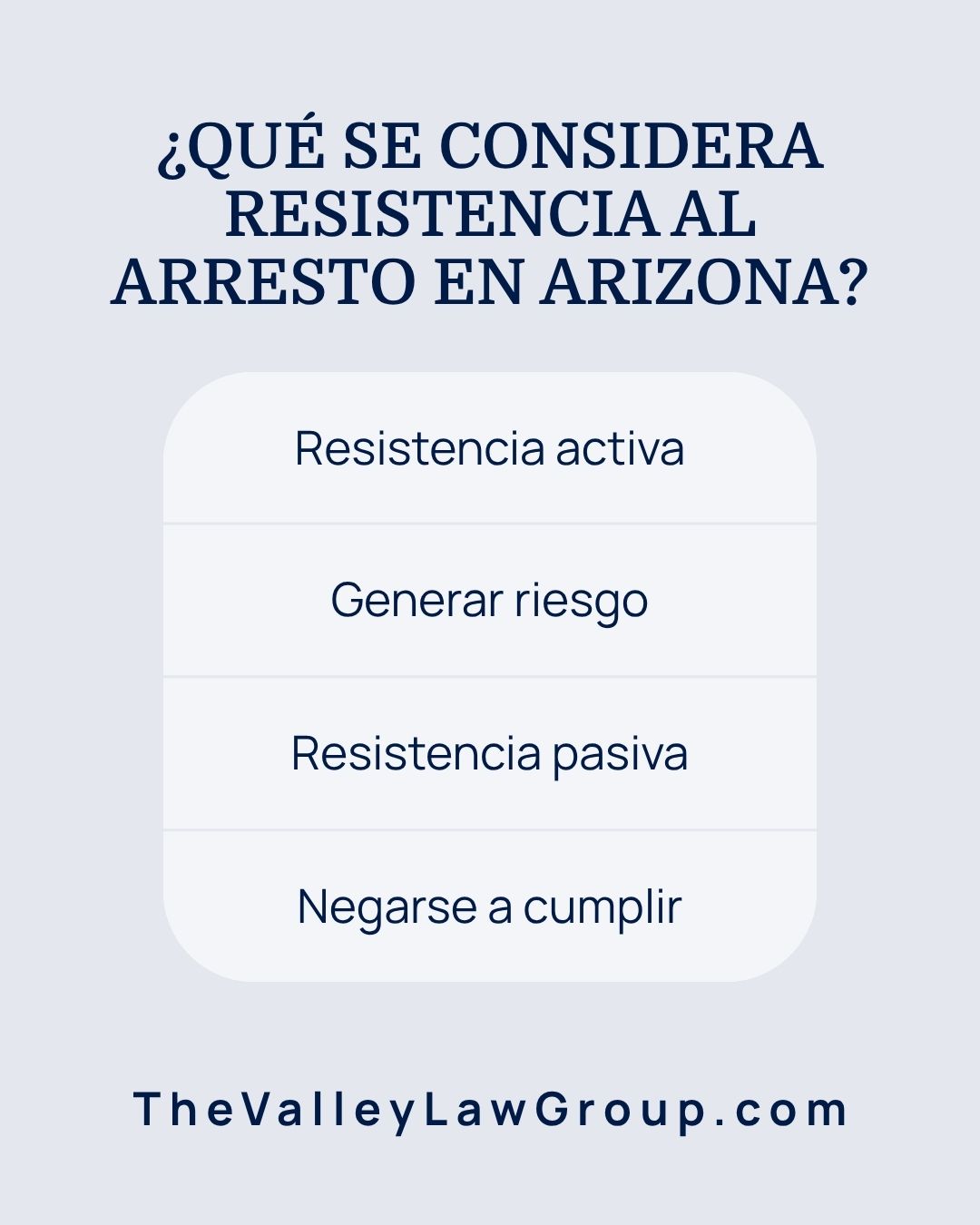
In Arizona, resisting arrest is classified as a public order and safety crime.
There are four main categories for resisting arrest charges in Arizona:
- Active Resistance – Active resistance is what typically comes to mind when resisting arrest. During active resistance, a suspect threatens to and/or actually uses physical violence directly against the arresting officer, creating a substantial risk of injury for anyone involved in the arrest.
- Creating Risk – Acting in any way that poses a substantial risk of physical injury to anyone involved, including law enforcement or bystanders, constitutes resisting arrest, even without active resistance. Examples include fleeing from officers or attempting to incite a crowd against law enforcement.
- Passive Resistance – Passive resistance encompasses a wide range of nonviolent physical actions or intentional refusals to follow instructions. These can include tucking the arms under the body, refusing to get into a police vehicle, and/or going limp.
- Refusal to Comply – If an accused deliberately fails to act in accordance with the officer’s instructions, they are hindering, delaying, or impeding the arrest process. A common example is refusing to place hands behind the back.
To secure a conviction for resisting arrest, an Arizona prosecutor must prove that the accused knew or should have known the officer arresting them was a peace officer acting in their official authority, but continued to resist despite this knowledge. That means even if you thought your initial arrest was in error and resisted on principle, you can still be charged with resisting arrest. Whether your arrest was justified or you were wrongly accused and viewed your resistance as peaceful, you need criminal defense representation to help you build your defense.
Is Resisting Arrest a Misdemeanor or Felony in Arizona?
According to Arizona Revised Statutes § 13-2508, resisting arrest is a public order crime that can be classified as a misdemeanor or a felony. Classification depends on how the alleged offense occurs, as well as the additional circumstances involved in the resistance.
Misdemeanor Resisting Arrest
Misdemeanor charges typically apply to cases in which the alleged resistor engaged in passive resistance, which involves a nonviolent refusal to cooperate. In misdemeanor cases, resistance occurs with the intent to hinder or delay arrest rather than to endanger law enforcement.
A conviction for misdemeanor resisting arrest typically results in up to six months’ jail time, probation, fines, and surcharges. Convictions of any crime, including misdemeanors, will be noted on your criminal record and can affect your ability to post bail.
Felony Resisting Arrest
Class 6 felony charges for resisting arrest can be issued when an individual purposefully attempts to prevent an arrest by threatening or using physical violence and force against the arresting officer. Felony charges may also be relevant when the suspect poses a substantial safety risk to surrounding individuals.
First-time felony offenses can result in probation and jail time lasting several months to a year. Repeat offenses, however, can result in longer prison sentences of up to five years, fines, and other elevated penalties.
Cases involving force, threats, and/or risk of injury result in more severe penalties than passive resistance, but both are considered crimes that can have a lasting effect on your criminal record and your life. It is crucial to retain a criminal defense attorney in Arizona to secure the best possible outcome in your case.
Common Defenses Against Resisting Arrest Charges
While being accused of resisting arrest may feel like the end of the world, as yet another charge is added to your criminal burden, an arrest is not a conviction. Several defense strategies may help you secure a dismissal or reduction in charges.
A skilled criminal defense lawyer can help you craft a solid Arizona resisting arrest defense that focuses on one of these six pillars:
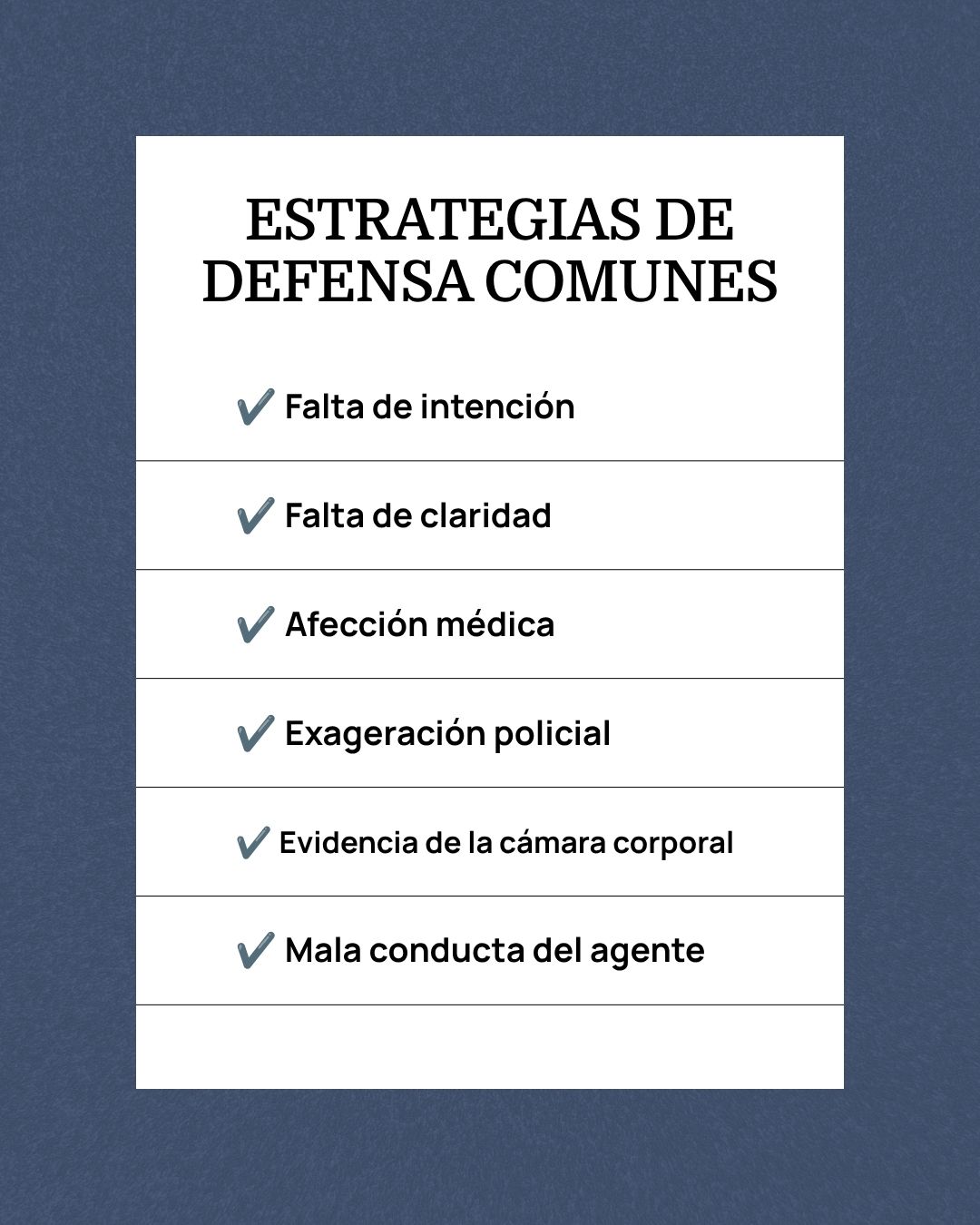
1. Unintentional Resistance
One potential defense strategy is to prove that you did not intentionally resist. Sometimes, the stress of a criminal situation can overwhelm those involved, leading a suspect to act out or even go into shock. If this happened to you, you may have felt as if you were operating without a full understanding of what your body was doing.
The prosecutor must prove intent to secure a conviction in a resisting arrest case. If your resisting arrest lawyer in Arizona can assert that you were not in control of your body at the time, you may be able to avoid a conviction.
2. Lack of Clarity
If the officer making the arrest did not make it clear they were attempting to arrest you, you may be able to build a lack-of-clarity defense.
For example, you might suggest that you would not have resisted if you had known what was really happening. Your attorney could demonstrate that the law enforcement officer did not state their identity, that you were under arrest, or the purpose of the interaction. Alternatively, your attorney can prove that you did not know the person was a law enforcement officer and assert that if you had known, you would not have actively or passively resisted.
3. Accidental Conduct and Misunderstandings
Arrests can be highly emotional and chaotic, leaving room for misunderstandings and/or accidents. For example, you may have been caught up in the melee as others were fleeing a crime, resulting in your arrest even though you were simply a bystander. Your attorney could claim accidental conduct and posit that it was understandable for you to resist arrest in the confusion.
Another common example is the potential for misunderstanding when a suspect has a health issue that limits their speed or mobility. If law enforcement experienced delays with compliance due to your disability, they may wrongfully view them as passive resistance, although the delays were outside of your control.
To secure a conviction, the prosecution must prove that you intentionally attempted to delay and/or prevent the arrest process. Unintentional actions, such as a fear response, confusion, or a medical condition, can be used to demonstrate accidental conduct or a misunderstanding, which could lead to a dismissal. A skilled criminal defense lawyer can highlight these kinds of mitigating factors that may not have been considered at the time of the arrest.
4. Police Exaggeration
Eyewitness testimony is almost always biased by personal experience, and even the most experienced and well-intentioned officers can inflate their accounts of a situation’s severity after the fact. Unfortunately, inexperienced officers or those with an ulterior motive may be even more likely to misrepresent or exaggerate your actions when questioned about the circumstances of your arrest.
Your lawyer can work to show the flaws and potential exaggerations found in a law enforcement officer’s recounting of events.
5. Evidentiary Proof
Evidence is typically a far more reliable witness than people could ever hope to be. It can be used to disprove events recounted by law enforcement as easily as to prove a suspect’s guilt. Your lawyer can use bodycam footage, security recordings, phone videos, or even human witnesses to defend against resisting arrest charges; evidence can show that the officer’s testimony was flawed, slanted, or even fabricated.
With the help of your lawyer, you can also draw attention to unintentional discrepancies, highlighting the potential room for error in the officer’s or witnesses’ testimonies. While the prosecution must prove your guilt beyond a reasonable doubt, a defense lawyer’s job is to plant doubt that the charges accurately reflect what occurred.
6. Officer Misconduct
A final strategy your defense lawyer may consider is suggesting that the arresting officer(s) used excessive, unlawful, and/or unwarranted force. These circumstances can transform any acts of resistance on your part into self-defense instead of illegal behavior. While most police officers put the law above their personal feelings, this is not necessarily true in all cases; sometimes, criminal suspects can become victims of brutality or other kinds of police misconduct.
If your rights have been violated during an arrest, resistance can be reframed as self-defense. A criminal defense lawyer can prove that an officer’s misconduct led you to feel the need to protect yourself.
Perspectiva jurídica de Jon McCarty, abogado director especializado en defensa penal
Every resisting arrest case is different. Many cases hinge on whether the defendant intentionally resisted, whether the officer’s actions were lawful, and what body camera footage or witness testimony actually shows. Early legal intervention can help preserve critical evidence and identify weaknesses in the prosecution’s case.
Evidence That Can Help Your Defense

Your defense lawyer can gather multiple types of evidence to support your defense strategy.
Common types of evidence for resisting arrest defense can include:
- Bodycam footage
- Dashcam footage
- Declaraciones de testigos
- Security footage
- Photographs of your injuries
- Medical records
- Dispatch records
- Informes policiales
- Bystander videos
A skilled Arizona resisting-arrest defense lawyer can thoroughly examine your case and gather evidence to support your defense.
Charges That May Come With Resisting Arrest
Resisting arrest is one of many public safety crimes in Arizona, and it is frequently paired with other public safety violations.
For example, resisting arrest charges are often paired with disorderly conduct charges. Understanding what constitutes disorderly conduct in Arizona is useful for examining the overlap between police encounters, public disturbance allegations, and resisting arrest.
Some examples of disorderly conduct in Arizona include:
- Creating unreasonable noise, such as loud arguments that disturb others
- Making threats to others, starting fights, displaying aggressive behaviors, or using foul language
- Refusing to disperse when police are protecting the safety of the public during an emergency or attempting to disrupt a meeting or procession
- Recklessly handling a weapon
Individuals arrested for resisting arrest and associated with disorderly conduct charges in Arizona need a strong defense that addresses both the original charge and the resistance. Resisting arrest is also frequently linked to DUI arrests, as well as arrests for assault, domestic violence, and probation violations. An attorney may build defenses around mistaken identity, defense of another person, violation of rights, insufficient evidence, defensive display of a firearm, or even accidental behavior.
Other charges directly connected to how you allegedly resisted arrest can include:
- Aggravated assault on an officer charges, which can occur when an individual uses physical force or involves a weapon, resulting in injury
- Criminal damage charges, which can occur if police equipment and/or uniforms are damaged or broken during the scuffle
- Eluding and/or fleeing charges, if you are believed to have run away on foot or escaped in a vehicle during the arrest process
Can Resisting Arrest Charges Be Reduced or Dismissed?
Yes, your resisting arrest charges can be reduced or dismissed in Arizona. In cases of resisting arrest, the potential for reduction or dismissal depends on the evidence, prior criminal record, whether other charges are involved, and whether the prosecution can prove every element of the case. A prosecutor or judge can reduce charges at any point during negotiations, as well as when your attorney argues for a plea bargain and/or mitigating penalties during sentencing for a conviction.
The best way to secure a dismissal or reduction in charges is to hire a skilled defense lawyer who knows how to defend against resisting arrest charges in Arizona. A seasoned lawyer has experience in Arizona criminal courts and deep knowledge of these charges. They can help you construct your defense case and help prevent this additional charge from having a detrimental impact on your future.
Your lawyer’s chief responsibility is to protect your rights, including your right to a fair trial, to be properly informed of your Miranda Rights, and to be treated as innocent until proven guilty. Your lawyer can ensure that you are treated with respect and dignity and protected from physical mistreatment and confirmation bias.
Cuándo ponerse en contacto con un abogado penalista
While you can contact and/or hire a criminal defense attorney at any time during your case before sentencing, it is better to do so as early as you can. Connecting with a lawyer the moment you are officially charged with resisting arrest can have a lasting impact on the outcome of your case and your life.
The skilled defense team at The Valley Law Group can help you in your moment of need. Our compassionate staff is available to schedule a consultation at any time. Make a quick call to connect with our team and discover how we can help you protect your rights, your record, and your future.
If you have been arrested and injured, accused of using force, or accused of nonviolent noncompliance, you need a skilled resisting arrest defense lawyer.
Resisting Arrest FAQs
Don’t face your resisting arrest charges alone. While resisting arrest can seem to pale in comparison to your initial charges, additional charges can have a lasting impact on your future, limiting job opportunities, affecting licensing or housing, and damaging your reputation.
Contact The Valley Law Group today to schedule a consultation and discover how we can help you build a defense against your resisting arrest charges. Our offices in the Valley area are proud to serve residents of Phoenix, Gilbert, Scottsdale, Peoria, and the surrounding areas.
Resource:
- Arizona Revised Statutes § 13-2508. (n.d.). Resisting arrest; classification; definitions. Retrieved July 2, 2026, from https://www.azleg.gov/ars/13/02508.htm

Jon McCarty tiene amplia experiencia en una gran variedad de asuntos de defensa penal y derecho de familia. Después de graduarse de la Facultad de Derecho de la Universidad de Illinois con los más altos honores, Jon sirvió como asistente legal del Honorable David Briones en el Tribunal de Distrito de los Estados Unidos para el Distrito Oeste de Texas. Después de ejecutar una práctica exitosa de su propia durante muchos años, Jon se trasladó al Condado de Maricopa, donde ha seguido luchando por la excelencia a través de la representación agresiva y compasiva de cada cliente. Jon ha sido nombrado a la lista de Super Lawyers en el área de derecho de familia en varias ocasiones, y ha sido reconocido por su destacado compromiso con la igualdad de acceso a la justicia a través de la prestación de representación pro bono a numerosos clientes.