



In this article, you’ll learn:
- When marijuana is legal in Arizona
- When marijuana can still lead to criminal charges
- What penalties may apply to marijuana possession, sale, or transportation
- How marijuana DUI cases work
- Whether older marijuana charges may qualify for expungement
- Why legal help matters if you are facing marijuana-related charges
Arizona allows adults 21 and older to use marijuana within certain limits. However, legalization does not mean every marijuana-related activity is permitted under the law. Possessing more than the legal amount, engaging in unauthorized sales, transporting marijuana for sale, driving while impaired, underage possession, and violating other marijuana laws can still result in criminal charges.
If you or someone you know is facing Arizona marijuana charges, understanding the difference between lawful possession and illegal conduct is an important first step. The circumstances of an arrest, the amount involved, and the evidence available can all affect how a case proceeds. An Arizona drug crime lawyer can help you understand your rights and evaluate your case.
Is Marijuana Legal in Arizona?
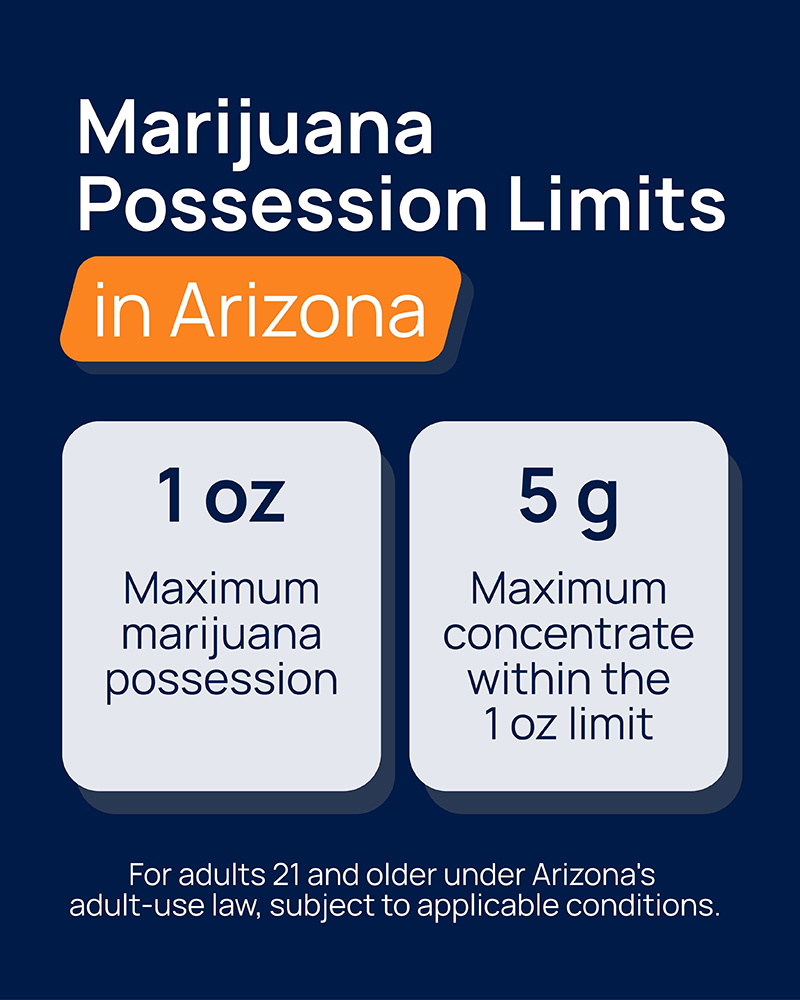
Arizona allows adults 21 and older to possess and use marijuana, also commonly called cannabis, within specific limits. Under A.R.S. § 36-2852, qualifying adults may generally possess, consume, purchase, or transport up to one ounce of marijuana, including no more than five grams of concentrate.
Arizona law also permits limited home cultivation, generally up to six plants per qualifying adult and no more than twelve plants per residence with two or more qualifying adults. Cultivation must meet specific security and visibility requirements.
Although cannabis and marijuana are often used interchangeably, Arizona law uses specific definitions depending on the statute. Understanding which law applies is important when determining whether an activity is legal or may result in criminal penalties.
When Can Marijuana Still Lead to Criminal Charges?
Despite legalization, people can face criminal consequences for marijuana-related conduct that is not protected by the law, including:
- Possession Over the Legal Limit: Possessing more than the permitted amount of marijuana may lead to a petty offense or more serious charge, depending on the circumstances and amount.
- Possession for Sale: Possessing marijuana with the intent to sell it unlawfully may result in felony charges.
- Unlawful Sale or Transfer: Transactions outside permitted exceptions can violate state law.
- Transportation for Sale: Transporting marijuana for unlawful sale or importing it into Arizona may trigger additional charges.
- Production Outside Legal Limits: Growing marijuana outside legal limits or violating cultivation requirements may result in penalties.
- Underage Possession: People under 21 do not have the same legal protections as qualifying adults.
- Marijuana DUI: Driving while impaired by marijuana is illegal.
- Use in Prohibited Places: Smoking marijuana in public places or open spaces may result in penalties. Other location-specific restrictions may also apply.
- Violations Involving Probation or Other Criminal Case Conditions: Probation conditions and other applicable restrictions may create separate legal issues.
Attorney Insight
One of the biggest misconceptions about marijuana in Arizona is that legalization eliminated marijuana crimes altogether. It did not. A case can be affected by a person’s age, the amount of marijuana involved, allegations of intent to sell, whether driving was involved, and prior convictions or probation conditions. Reviewing these details can help determine whether the evidence supports the charges.
Marijuana Possession Charges in Arizona
Marijuana possession charges in Arizona depend on the amount involved, the purpose of possession, the age of the alleged offender, and whether an exception applies under state law. Under A.R.S. § 13-3405, certain marijuana-related conduct, including unlawful possession, use, production, sale, and transportation, remains prohibited except as allowed by Arizona’s adult-use laws.
Under A.R.S. § 36-2853, possessing more than one ounce but no more than 2.5 ounces of marijuana, including no more than 12.5 grams of concentrate, generally constitutes a petty offense. Possession beyond those limits may lead to felony charges under A.R.S. § 13-3405, depending on the amount involved and whether an applicable legal exception exists.
How Much Marijuana Is a Felony in Arizona?
For ordinary adult possession that is not intended for sale, marijuana quantities exceeding the amounts protected by Arizona’s adult-use laws may result in felony charges.
Under A.R.S. § 13-3405, unlawful possession of less than two pounds of marijuana is generally classified as a class 6 felony when the exceptions under Arizona’s adult-use laws do not apply. Larger quantities may carry higher felony classifications.
Possession for sale, unlawful production, and transportation for sale are treated separately and may result in more serious charges.
Prosecutors may consider the amount, packaging, surrounding circumstances, and other evidence when determining a charge. Depending on the specific offense, penalties may include fines, incarceration, probation, or other legal consequences. The classification of the charge and the person’s criminal background can also affect the case.
For more information, see our guides to drug possession laws in Arizona and penalties for drug crimes in Arizona. An attorney can review the allegations, examine the evidence, and identify potential issues involving a stop, search, seizure, or prosecution.
Possession for Sale, Transportation, and Distribution
Marijuana allegations may become more serious when prosecutors believe the substance was intended for sale or distribution. Under A.R.S. § 13-3405, possession for sale, unlawful production, sale, transfer, and transportation for sale are addressed separately from ordinary possession.
Prosecutors may rely on several forms of evidence when arguing that marijuana was intended for sale, including:
- Quantity: The amount found may be considered.
- Packaging: Individual packages or other preparation may be used as evidence of intended distribution.
- Cash: The amount of money present and the surrounding circumstances may be considered.
- Scales: The presence of scales may be used to support allegations of preparation for distribution.
- Messages: Text messages, social media exchanges, or other forms of communication may be included in the case.
- Prior Sales Allegations: Allegations of past sales may be relevant depending on the evidence and applicable legal rules.
- Location and Context of Arrest: Where the arrest occurred and what law enforcement observed may affect the prosecution’s case.
None of these factors automatically establishes guilt on its own. Their significance depends on the full circumstances, the available evidence, and whether all required elements of the offense can be proven.
Transportation for sale may also raise separate issues, particularly when allegations involve larger quantities or movement across state lines. Learn more in our guide to Arizona drug trafficking laws.
Can You Get a DUI for Marijuana in Arizona?
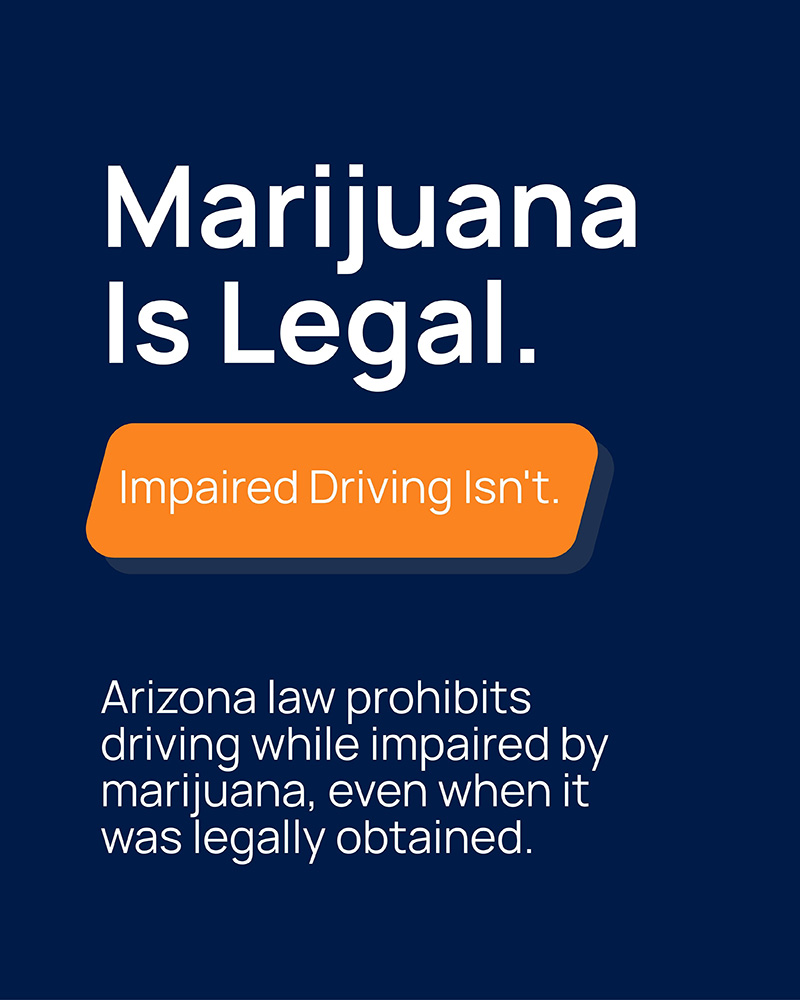
Arizona law prohibits driving while impaired by marijuana, even when it was legally purchased or possessed. Under A.R.S. § 28-1381, a person may face DUI charges for driving or being in actual physical control of a vehicle while impaired by a drug to the slightest degree.
Under A.R.S. § 36-2852(B), the presence of marijuana components or metabolites alone is insufficient for a conviction under A.R.S. § 28-1381(A)(3) unless the person was also impaired to the slightest degree.
Officers may consider observations, statements, field sobriety testing, toxicology reports, and other evidence. However, a positive test does not necessarily establish when marijuana was consumed or whether the driver was impaired while driving.
Marijuana-related DUI allegations can involve complicated questions about impairment and chemical testing. Learn more about DUI and vehicular crimes in Arizona.
Marijuana Charges and Juvenile or Underage Cases
Arizona’s adult-use marijuana protections generally apply to adults 21 and older. Under A.R.S. § 36-2853, a first qualifying underage possession violation involving one ounce or less of marijuana, including no more than five grams of concentrate, may result in a civil penalty of up to $100 and possible drug education or counseling.
A second qualifying violation is a petty offense, while a third or subsequent violation may be charged as a class 1 misdemeanor.
These classifications apply to the specific conduct and quantities covered by the statute. Other circumstances may involve different charges or juvenile court procedures.
Even a relatively minor violation can affect school, driving privileges, future educational and employment opportunities, and other aspects of a young person’s life, depending on the circumstances. It is important to understand how Arizona’s marijuana laws apply to people under 21 rather than assuming that legalization for adults makes underage possession lawful.
Can Marijuana Charges Be Expunged in Arizona?
Under A.R.S. § 36-2862, certain marijuana-related arrests, charges, adjudications, convictions, and sentences arising from conduct before the law took effect may qualify for expungement. Eligible individuals have been able to petition the court for expungement since July 12, 2021.
Qualifying offenses include:
- Possessing, consuming, or transporting up to 2.5 ounces of marijuana, with no more than 12.5 grams in concentrated form
- Possessing, transporting, cultivating, or processing up to six marijuana plants at a primary residence for personal use
- Possessing, using, or transporting certain marijuana paraphernalia
Not every marijuana offense qualifies for expungement. For instance, a sale conviction is not automatically eligible simply because the amount involved falls within the possession limit.
If you believe an earlier marijuana offense may qualify, learn more about eligibility and the petition process in our guide to expungement in Arizona. An attorney can help review your circumstances and explain your legal options.
What to Do if You Are Facing Marijuana Charges in Arizona
If you are facing marijuana charges in Arizona, consider these practical steps:
- Do not assume the case is minor because marijuana is legal in some situations. Legal possession does not make every marijuana-related activity lawful.
- Exercise your legal rights during police questioning. Before discussing the allegations, consider requesting an attorney and clearly invoking your right to remain silent.
- Save all paperwork. Keep citations, court notices, charging documents, booking paperwork, and release conditions.
- Avoid posting about the case online. Posts and messages may become relevant to an investigation.
- Document relevant medical marijuana status. If applicable, preserve records showing whether you had a valid medical marijuana card or another legally relevant authorization.
- Speak with a drug crime lawyer in Arizona. A criminal defense attorney can evaluate the allegations, examine evidence, and explain potential defenses.
A lawyer may review whether a stop or search was lawful, whether the evidence supports the charges, and whether statutory exceptions or other defenses apply. Getting advice early can also help you understand upcoming deadlines and avoid making mistakes while the case is pending.
Marijuana Charges in Arizona FAQs
Arizona’s marijuana laws can be confusing, especially when certain activities are legal while others can still lead to penalties. These frequently asked questions cover possession limits, potential charges, and when legal representation may help you understand your rights and options.

How The Valley Law Group Can Help With Marijuana Charges
The Valley Law Group assists clients facing marijuana possession, possession for sale, transportation, DUI, expungement, and other drug-related criminal defense issues.
Our Arizona drug crime attorneys can review the facts, examine evidence, assess potential search-and-seizure issues, review any prior record, and explain possible defense strategies. The right approach depends on the specific allegations and circumstances.
Whether you are facing a first-time marijuana offense or more serious felony drug allegations, understanding your options early can make the legal process easier to navigate.
Facing Marijuana Charges in Arizona?
Contact The Valley Law Group today to schedule a consultation with an Arizona criminal defense attorney about marijuana possession, DUI, or other drug-related charges.
Fuentes
All sources accessed November 12, 2026.
- Arizona State Legislature. (n.d.). A.R.S. § 36-2852: Allowable possession and personal use of marijuana, marijuana products and marijuana paraphernalia. Arizona Revised Statutes. https://www.azleg.gov/ars/36/02852.htm
- Arizona State Legislature. (n.d.). A.R.S. § 36-2853: Violations; classification; civil penalty; additional fine; enforcement. Arizona Revised Statutes. https://www.azleg.gov/ars/36/02853.htm
- Arizona State Legislature. (n.d.). A.R.S. § 13-3405: Possession, use, production, sale or transportation of marijuana; classification; exceptions. Arizona Revised Statutes. https://www.azleg.gov/ars/13/03405.htm
- Arizona State Legislature. (n.d.). A.R.S. § 28-1381: Driving or actual physical control while under the influence; trial by jury; presumptions; admissible evidence; sentencing; time limitation; violation; classification; definition. Arizona Revised Statutes. https://www.azleg.gov/ars/28/01381.htm
- Arizona State Legislature. (n.d.). A.R.S. § 36-2862: Expungement; petition; appeal; dismissal of complaints; rules. Arizona Revised Statutes. https://www.azleg.gov/ars/36/02862.htm
- Arizona Judicial Branch. (n.d.). Proposition 207: Frequently asked questions. https://www.azcourts.gov/prop207/FAQ

Jon McCarty tiene amplia experiencia en una gran variedad de asuntos de defensa penal y derecho de familia. Después de graduarse de la Facultad de Derecho de la Universidad de Illinois con los más altos honores, Jon sirvió como asistente legal del Honorable David Briones en el Tribunal de Distrito de los Estados Unidos para el Distrito Oeste de Texas. Después de ejecutar una práctica exitosa de su propia durante muchos años, Jon se trasladó al Condado de Maricopa, donde ha seguido luchando por la excelencia a través de la representación agresiva y compasiva de cada cliente. Jon ha sido nombrado a la lista de Super Lawyers en el área de derecho de familia en varias ocasiones, y ha sido reconocido por su destacado compromiso con la igualdad de acceso a la justicia a través de la prestación de representación pro bono a numerosos clientes.