



In This Post, You’ll Learn
- The difference between a family court appeal and a modification
- When an appeal may be appropriate
- When a modification may be the better option
- How timing, evidence, and changed circumstances may affect your options
- Why legal guidance matters before challenging or changing a family court order
Knowing the difference between an appeal vs. modification in an Arizona family court proceeding can help you better understand your legal options.
An appeal usually asks a higher court to review the original decision, while a modification asks the family court to change the existing order when circumstances change. Each process has different requirements, deadlines, and purposes. Choosing the wrong approach can delay necessary changes and create additional stress.
If you are unsure what to do after a court ruling, Arizona family court appeal resources can help. Below, we explain the difference between a family court appeal and a modification so you can better understand your options.
What Is a Family Court Appeal?
A family court appeal involves a higher court reviewing whether the trial court made a legal or procedural error. An appeal of a family court decision in Arizona focuses on whether the original court applied the law correctly and followed the required legal process.
However, an appeal is not an opportunity to retry the entire case. The appellate court generally reviews the record created in the original family court proceeding rather than hearing the same evidence again. Appeals can take time, and the process is very different from returning to family court to ask for a new or changed order.
State law establishes deadlines for filing an appeal. Missing these deadlines can affect your ability to seek review. Depending on the circumstances, a party may be able to appeal a child support order, divorce judgment, custody-related order, or another family court ruling.
What Is a Family Court Modification?
A family court modification is not the same thing as an appeal. A modification asks the family court to change an existing order, usually because circumstances have changed. This may happen if a parent’s work schedule changes, a parent’s financial situation changes significantly, a parent relocates, or a child’s needs change.
Modifications remain in the family court system. Changes may involve custody or legal decision-making authority, parenting time, child support, and spousal maintenance.
To modify a family court order in Arizona, the requesting party must meet the legal requirements that apply to that specific type of order. The legal standard depends on the type of order being modified. For example, child support or spousal maintenance modifications often require a substantial and continuing change in circumstances. Legal decision-making and parenting time modifications may have different timing requirements, including restrictions on how soon a parent can request changes after an order is entered unless safety concerns or other qualifying circumstances exist.
Appeal vs. Modification: The Main Difference
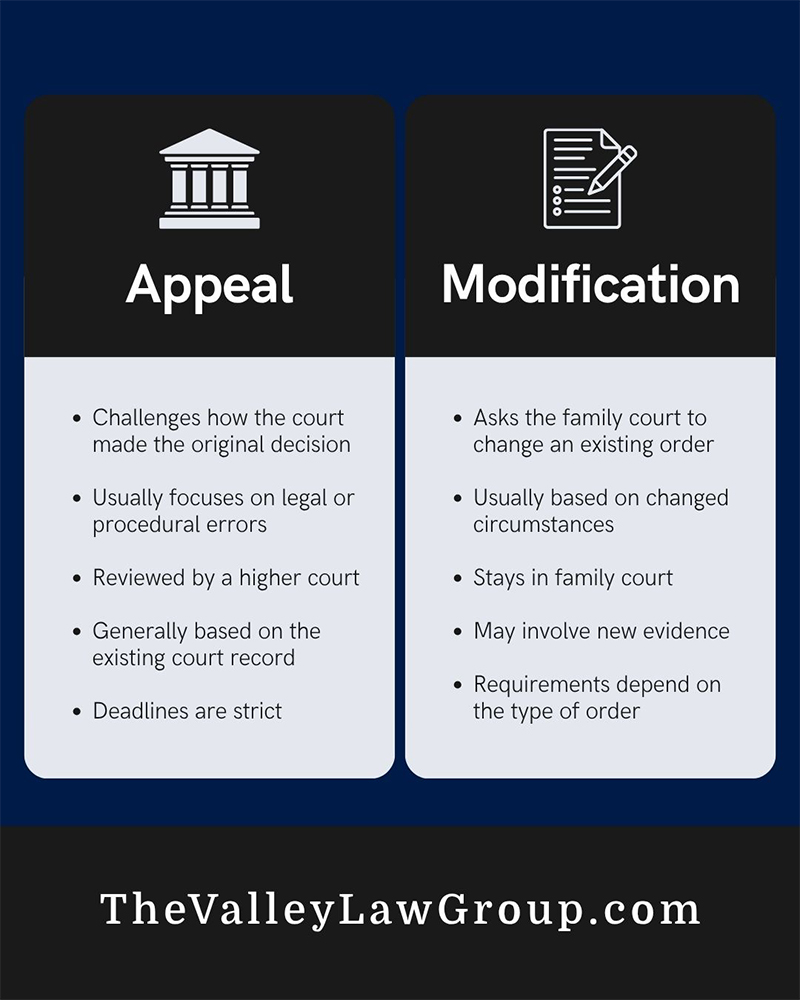
To understand appeal vs. modification in Arizona family court, you need to identify what you are challenging and why.
An appeal challenges how the court made the original decision. If you believe the judge misapplied the law, followed the wrong legal standard, or made a procedural error during your case, an appeal may be appropriate.
A modification asks the court to change an existing order because circumstances have changed.
For example, a petition for a custody modification in Arizona or a parenting time modification in Arizona may be necessary if the existing order no longer works for the child or family.
In simple terms:
- An appeal challenges the original court decision.
- A modification asks the court to change an existing order based on current circumstances.
When Might an Appeal Be Appropriate?
An Arizona family court appeal may be appropriate when the court reaches an incorrect outcome because of a legal or procedural issue. Simply disagreeing with a judge’s decision does not automatically provide grounds for an appeal.
An appeal may raise concerns about procedural errors that prevented a party from presenting their case or about whether the court followed the proper legal process. A party may also argue that the decision was not supported by the evidence presented in the original proceeding.
An appellate court may review whether the trial court abused its discretion when making certain decisions. To appeal a family court decision in Arizona, you need to understand the specific issue that occurred.
For example, a parent considering a custody appeal should review how to appeal a child custody ruling, while a parent wanting to appeal a child support order should understand how that process works.
When Might a Modification Be Appropriate?
A modification may be appropriate if circumstances have substantially changed since the original family court order was entered. The right approach depends on the type of order and the legal requirements that apply. Unlike an appeal, the focus is on what is happening now, rather than on alleged errors in the original proceedings.
Some situations that may lead a parent to consider requesting a modification include:
- A significant change in income. A substantial increase or decrease in income can affect child support and may require a child support modification in Arizona.
- A change in a parent’s circumstances. If a parent relocates, switches jobs, or experiences a major change in work schedule, the original parenting arrangements may need to be adjusted.
- A child’s changing needs. As children grow, their education, medical needs, developmental needs, and care needs may change.
- New safety concerns. If a parent is concerned about the child’s safety or well-being, they may ask the court to reconsider the existing order.
- A parenting schedule that no longer works. School, extracurricular activities, transportation issues, and work schedules can make an existing parenting schedule impractical.
- Serious issues affecting parenting. Domestic violence, substance abuse, neglect, or other significant concerns may require court involvement.
- A change affecting the child’s best interests. Sometimes, new circumstances develop that require changes to better serve the child’s overall best interests.
Can You Use New Evidence in an Appeal or Modification?
Whether new evidence can be considered depends on whether you are pursuing an appeal or asking the court to modify an existing order.
An appeal generally focuses on the record created in the original family court case. The appellate court reviews the evidence presented to the trial court and whether the trial court made a legal or procedural error. Because of this, a party usually cannot use an appeal to introduce new evidence in a family law appeal that was not presented in the original proceeding.
A modification is different. New evidence is often important when asking the court to change an existing order. Evidence about a parent’s circumstances, the child’s needs, income changes, living arrangements, safety concerns, or other current facts may help the court determine whether a modification is appropriate.
Why Timing Matters
Both appeals and modifications are time-sensitive, but the deadlines and requirements are different.
Appeals have strict filing timelines. Waiting too long to file can affect your ability to obtain appellate review. Modifications have different timing considerations because they often depend on changed circumstances, the type of order involved, and whether the law allows a modification request at that time.
Some situations require immediate attention, especially when a child’s safety is a concern. It is important to speak with an Arizona family law attorney as soon as you believe an appeal, modification, or other court filing may be necessary. An attorney can review the order, identify the correct process, and help you avoid delays or procedural problems.
What If You Are Unsure Which Option Applies?

After receiving an unfavorable family court ruling, you may be unsure what to do next. You may not know whether you need to file an appeal, request a modification, or pursue another type of court filing. The answer depends on the original order, how much time has passed, what legal issue exists, and what has changed since the order was entered.
The first step is getting legal guidance about your specific situation so you can better understand your options and move forward with clarity. If a motion is appropriate, knowing the available Arizona family court motions can give you some necessary direction.
Because the wrong filing can cause delays or procedural issues, it is usually best to speak with an attorney before deciding whether to appeal, modify, or file another type of motion. Getting legal advice before filing can help you avoid unnecessary extra steps and focus on the strategy that fits your situation.
Attorney Insight:
One of the biggest mistakes people make after an unfavorable family court ruling is assuming that every bad outcome requires an appeal. In many cases, the better path may be a modification, motion, or another targeted filing. The right strategy depends on the order, timing, the legal issue, and whether the court can consider new facts.
FAQs About Appeals and Modifications in Arizona Family Court
Explore some of the most common questions about appeals and modifications in Arizona family court.
Cómo puede ayudar The Valley Law Group
It is not uncommon to feel overwhelmed after a family court ruling. The Valley Law Group can help you understand your goals, review the existing order, and evaluate the circumstances surrounding the dispute. No two cases are the same, so our firm develops legal strategies based on the facts, timing, and issues involved.
The Valley Law Group’s family law team handles a wide range of legal matters, including divorce, child custody, child support, domestic violence, relocation, modifications, and appeals. Our experience with family court matters can help you better understand whether an unfavorable ruling should be challenged through an appeal, addressed through a modification, or handled through another court procedure.
Our team keeps clients informed throughout the process and answers questions about available options and next steps. We advocate for parents and children while keeping the child’s best interests and your long-term goals in mind.
With offices in Phoenix, Gilbert, Scottsdale, and Peoria, our team serves clients throughout Arizona. We can review your situation and help you understand what legal options may be available.
Póngase en contacto con The Valley Law Group hoy
If you are unsure whether to pursue an appeal, modification, or another family court filing, you do not have to go through the process alone. Contact The Valley Law Group today to schedule a free consultation and learn more about appeal vs. modification in Arizona family court.
Recursos:
- Arizona Department of Economic Security. (n.d.). Parents who pay child support. https://des.az.gov/services/child-and-family/child-support/parents-who-pay-child-support
- Arizona Legislature. (n.d.). A.R.S. § 25-327: Modification and termination of provisions for maintenance, support and property disposition. https://www.azleg.gov/ars/25/00327.htm
- Arizona Legislature. (n.d.). A.R.S. § 25-411: Modification of legal decision-making or parenting time; affidavit; contents; military families. https://www.azleg.gov/ars/25/00411.htm
- Arizona Legislature. (n.d.). A.R.S. § 25-503: Order for support; methods of payment; modification; termination; statute of limitations; judgment on arrearages; notice; security. https://www.azleg.gov/ars/25/00503.htm
- Arizona Judicial Branch. (n.d.). Rules of Civil Appellate Procedure. https://www.azcourts.gov/rules/Recent-Amendments/Rules-of-Civil-Appellate-Procedure

Jonathan Roeder es socio fundador de The Valley Law Group y un abogado de Arizona especializado en derecho de familia, defensa penal y daños personales. Jonathan ha centrado su práctica en ayudar a los clientes a afrontar cuestiones legales complejas mediante una orientación clara, estrategias prácticas y una defensa firme. Como abogado, empresario y padre de tres hijos, comprende la importancia de la preparación, la comunicación y de ayudar a los clientes a tomar decisiones informadas en momentos de estrés e incertidumbre. La carrera de Jonathan refleja tanto el reconocimiento profesional como su compromiso con el desarrollo de otras personas en el ámbito jurídico. Ha obtenido numerosos galardones legales, entre los que se incluyen el reconocimiento como «Super Lawyers Rising Star» y una calificación de 10,0 («Excelente») en Avvo, al tiempo que ejerce de mentor de estudiantes de Derecho y jóvenes abogados a través de su labor como profesor universitario y líder en su sector.