



In This Article, You’ll Learn:
- What joint legal decision-making means in Arizona
- Why school choice and medical decisions often lead to parenting disputes
- How tie-breaker authority may work in a parenting plan
- What judges may consider when parents are deadlocked
- What evidence may help support your position
- When to speak with a family law attorney about decision-making disputes
Sharing joint legal decision-making with your child’s other parent can create conflict when major decisions need to be made about school, medical care, therapy, or other important parts of your child’s life. When an Arizona court awards joint legal decision-making, it does not mean the parents will always agree.
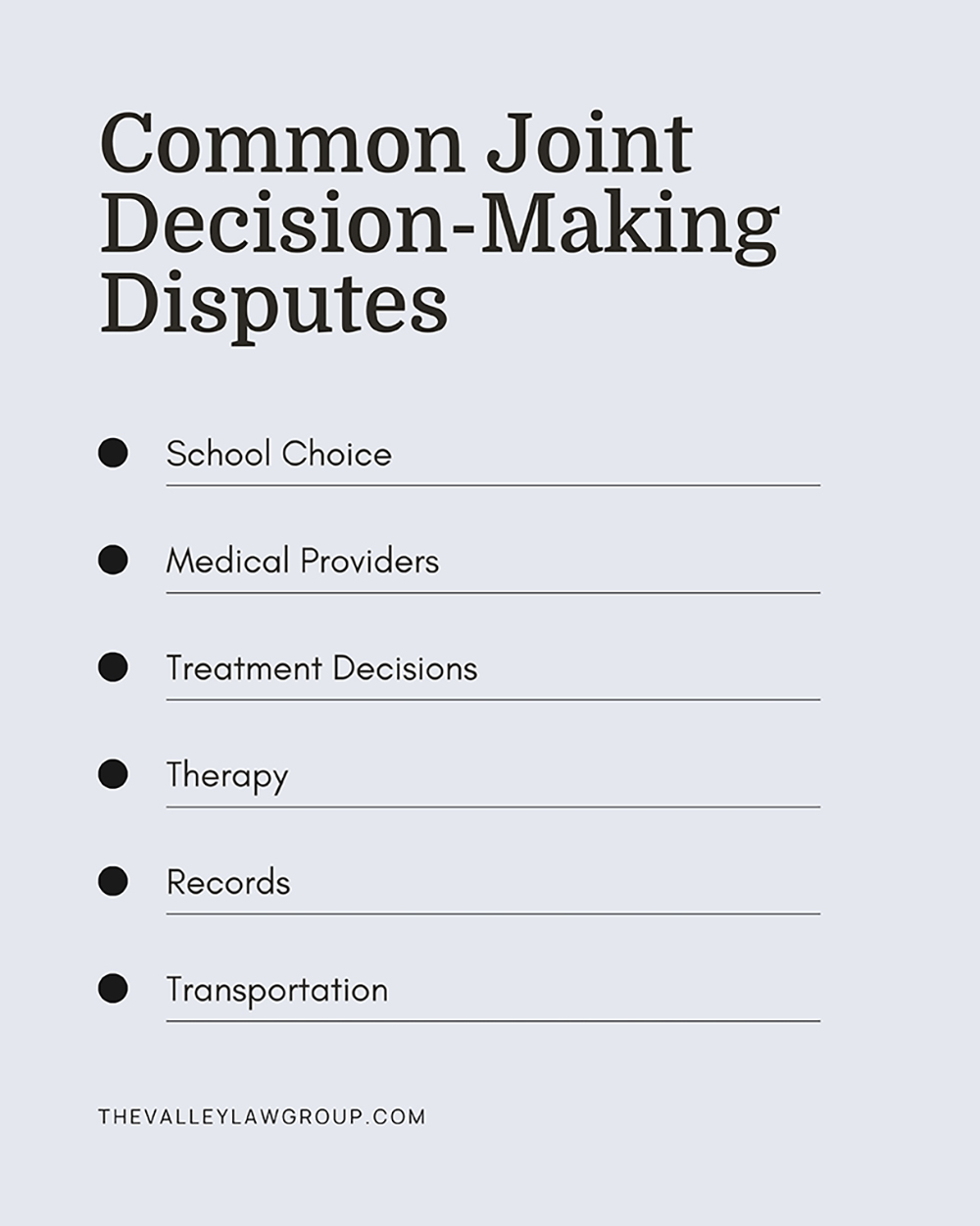
Common points of disagreement may include where the child should attend school, whether the child should switch schools, which doctor or therapist the child should see, whether a recommended treatment is necessary, or whether specialized therapy or educational support is needed.
When parents cannot agree, the parenting plan and court order become extremely important. The Valley Law Group helps Arizona parents understand their child custody rights, review parenting plan language, and pursue court orders that reflect the child’s best interests.
What Is Joint Legal Decision-Making in Arizona?
In Arizona, child custody has two main components: parenting time and legal decision-making.
Parenting time refers to when the child spends time with each parent according to the parenting plan or court order. Legal decision-making refers to the legal authority to make major non-emergency decisions for the child, including decisions about education, healthcare, religious training, and personal care.
Under Arizona Revised Statutes § 25-401, joint legal decision-making means both parents share the legal right and responsibility to make major non-emergency decisions for the child. In joint legal decision-making, neither parent’s rights or responsibilities are superior to the other parent’s unless the court order or final judgment gives one parent authority over specific decisions.
This means parents with joint legal decision-making usually need to consult each other on major school and medical decisions unless their parenting plan or court order says otherwise.
Why School Choice and Medical Decisions Cause Disputes
When parents share joint legal decision-making, they must make major decisions together in the child’s best interests. Two common areas of disagreement involve education and healthcare.
Education Decisions
School choice disputes in Arizona family court can involve many aspects of a child’s education, including:
- Education options: A child may attend a neighborhood school, open-enrollment school, charter school, private school, online school, or homeschool program. Parents may disagree about which option best serves the child’s needs.
- Logistical concerns: School choice can affect transportation, parenting time schedules, commute times, extracurricular activities, after-school care, and each parent’s ability to participate in the child’s school life.
- Academic needs: Parents may disagree about whether the child needs tutoring, special education services, a different academic environment, or access to specific programs.
- Differing educational philosophies: Parents may have different views about academic performance, religious education, homeschooling, extracurricular involvement, or special services.
Medical Decisions
Medical decision disputes in Arizona custody cases can also happen for many reasons, including:
- Provider preferences: Each parent may prefer a different pediatrician, therapist, counselor, specialist, or surgeon.
- Treatment decisions: Parents may disagree about whether a recommended treatment is necessary, whether medication is appropriate, whether the child should receive counseling, or whether ongoing therapy is needed.
- Vaccination or preventive care disputes: Parents may disagree about vaccinations, routine care, dental care, mental health treatment, or other preventive health decisions.
- Ambiguous custody orders: If the parenting plan does not clearly explain who has authority to make certain decisions, parents may need court clarification.
- Privacy and records issues: Parents may disagree about access to medical, therapy, school, or mental health records.
- Cost and logistics: Parents may dispute insurance coverage, out-of-pocket expenses, transportation, appointment scheduling, or follow-through with treatment recommendations. If the dispute involves uncovered healthcare costs or reimbursement, parents may also need to understand how Arizona handles medical expenses in child support.
Does Joint Legal Decision-Making Mean Both Parents Must Agree?
Joint legal decision-making often means that both parents must consult each other and attempt to make major decisions together. However, the exact process depends on the parenting plan and court order.
Some parenting plans require both parents to agree before a major educational or medical decision is final. Others give one parent final authority over specific areas, such as education, healthcare, therapy, or religious decisions, after the parents have made a good-faith effort to resolve the disagreement.
Without a court order giving one parent final authority, neither parent automatically has superior decision-making rights in a joint legal decision-making arrangement.
Because the details matter, parents should carefully review their parenting plan before making major decisions without the other parent’s agreement.
What Is Tie-Breaker Authority?
Tie-breaker authority is a form of final decision-making authority that may allow one parent to make a final decision in a specific category when parents with joint legal decision-making cannot agree.
For example, a parenting plan may state that both parents share joint legal decision-making, but one parent has final authority over school choice after consulting the other parent. In another case, one parent may have final authority over medical decisions while the other parent has final authority over education decisions.
Tie-breaker authority must come from the parenting plan or court order. It does not automatically exist simply because parents share joint legal decision-making.
Using tie-breaker authority also does not necessarily convert the arrangement from joint legal decision-making to sole legal decision-making. However, the parent using final authority should still act reasonably, follow the court order, consider the child’s best interests, and document the decision-making process.
How Judges May Resolve Parent Deadlocks
Arizona courts decide legal decision-making and parenting time based on the child’s best interests. Under Arizona Revised Statutes § 25-403, the court considers several best-interest factors when deciding legal decision-making and parenting time.
When parents are deadlocked over a school or medical decision, the court may review the parenting plan, the history of cooperation between the parents, the child’s needs, and the evidence supporting each parent’s position.
Depending on the facts, the court may consider options such as:
- Clarifying the existing parenting plan
- Modifying legal decision-making authority under A.R.S. § 25-403.01
- Giving one parent final authority over a specific category of decisions
- Changing joint legal decision-making to sole legal decision-making when legally appropriate
- Ordering mediation or another dispute resolution process
- Appointing a parenting coordinator when appropriate
- Entering specific orders about school enrollment, medical treatment, therapy, records, or communication
The court usually does not focus on which parent is more frustrated. The key issue is which decision or arrangement best supports the child’s needs, stability, safety, and best interests.
Evidence That May Help in a School Choice Dispute
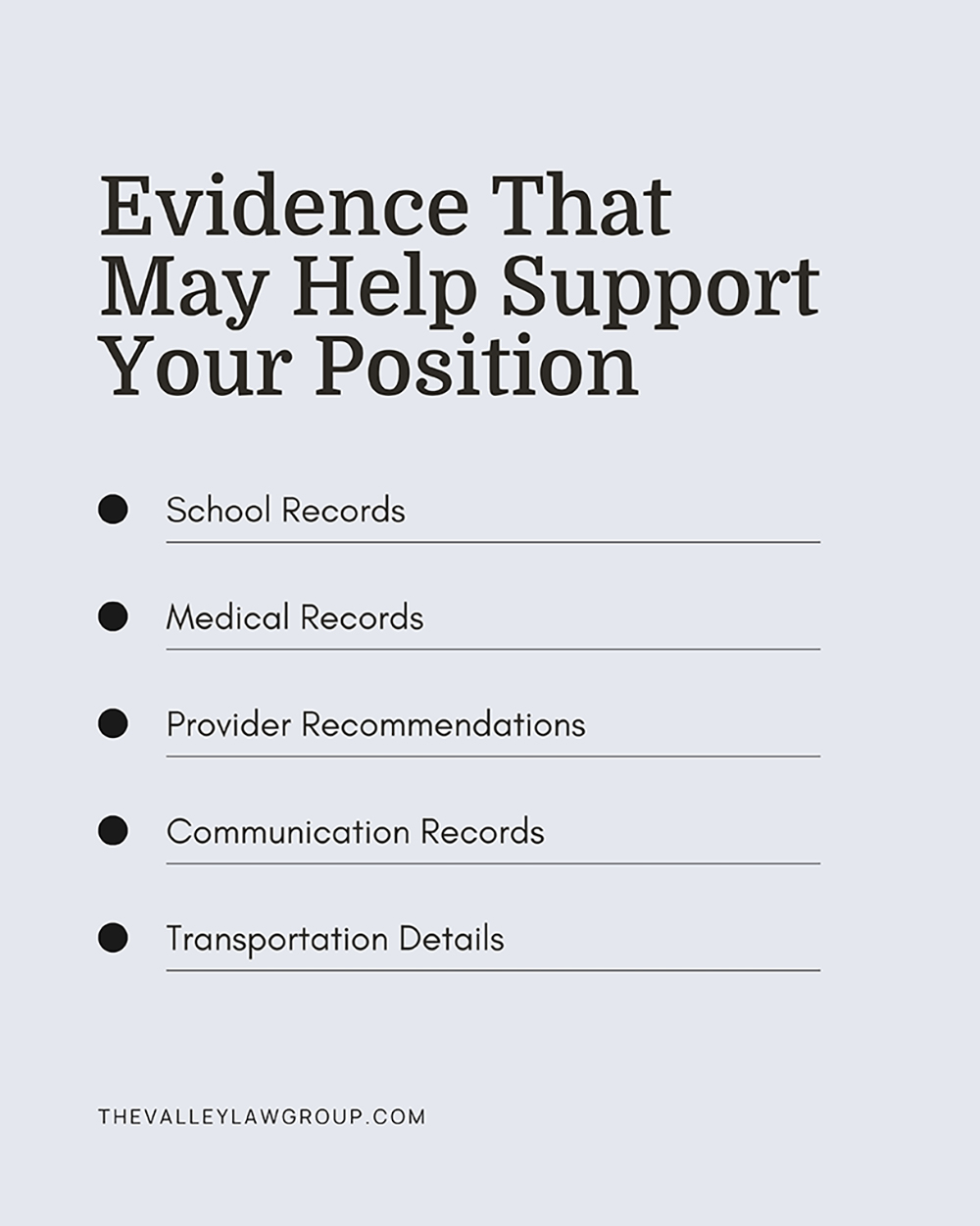
If you are involved in a school choice dispute, evidence can help show why your proposed option supports the child’s best interests.
Useful evidence may include:
- School performance records
- Attendance records
- Progress reports
- IEP or 504 plan documentation
- Teacher, counselor, or administrator recommendations
- School ratings or program information
- Transportation and commute details
- Childcare or after-school care information
- Records showing how the child has adjusted to the school and community
- Information about special programs, services, or extracurricular opportunities
- Written communication between the parents about school concerns
Evidence That May Help in a Medical Decision Dispute
If you and your child’s other parent cannot agree on a medical, mental health, or therapy-related decision, documentation may help the court understand the child’s needs and the basis for your position.
Helpful evidence may include:
- Medical records
- Doctor, therapist, or counselor recommendations
- Specialist evaluations
- Treatment plans
- Prescription history
- Records of missed appointments or refusal to cooperate
- Insurance and cost information
- Proof of symptoms, diagnosis, needs, and prognosis
- School records connected to the child’s health or learning needs
- Written communication between the parents about medical concerns
Attorney Insight
In school and medical decision disputes, the strongest position is usually the one supported by clear evidence of the child’s needs, stability, and best interests. Courts care less about which parent is frustrated and more about whether the proposed decision is practical, well-supported, and child-focused.
What if One Parent Makes Decisions Without Agreement?
If one parent makes a major school or medical decision without the other parent’s knowledge or consent, there may be legal consequences if a joint legal decision-making order is in place.
The other parent may need to ask the court for clarification, enforcement, modification, or other relief. Depending on the facts, the court may review whether the parent violated the court order, acted against the child’s best interests, refused to communicate, or misused any final decision-making authority granted in the parenting plan.
If the parenting plan includes tie-breaker authority, the parent using that authority may still need to show that they followed the required process, consulted the other parent when required, and made a reasonable decision focused on the child’s best interests.
When Can Legal Decision-Making Be Modified?
Legal decision-making may be modified when the legal requirements are met and a change is in the child’s best interests. Parents may seek a modification when an existing parenting plan no longer works, when parents repeatedly cannot make joint decisions, or when new circumstances affect the child’s needs or safety.
A modification request may involve school issues, medical care, mental health treatment, parenting time problems, relocation, domestic violence, or ongoing conflict that prevents effective co-parenting. Domestic violence and child abuse considerations are addressed under Arizona Revised Statutes § 25-403.03.
Appeals and modifications are different. An appeal challenges a court decision based on legal issues after the order is entered. A modification asks the court to change an existing order because circumstances have changed or because the current arrangement is no longer appropriate under the law.
A family law attorney can help you understand whether your issue should be handled through enforcement, clarification, modification, emergency relief, or another legal process.
FAQs About School and Medical Decision Disputes in Arizona
Co-parenting with joint legal decision-making can be challenging, especially when parents disagree about school, medical care, therapy, or other major decisions. These are some of the most common questions Arizona parents ask.
Cómo puede ayudar The Valley Law Group
The Valley Law Group’s family law attorneys understand how difficult co-parenting can become when parents disagree about important decisions involving a child’s education, healthcare, therapy, or daily stability.

Whether you are creating a new parenting plan, trying to interpret an existing order, responding to a co-parent’s unilateral decision, or seeking a modification, our team can help you understand your rights and options.
Podemos ayudarte con:
- Medical records
- Doctor, therapist, or counselor recommendations
- Specialist evaluations
- Treatment plans
- Prescription history
- Records of missed appointments or refusal to cooperate
- Insurance and cost information
- Proof of symptoms, diagnosis, needs, and prognosis
- School records connected to the child’s health or learning needs
- Written communication between the parents about medical concerns
Co-parenting disputes can feel overwhelming, especially when your child’s education or health is involved. You do not have to navigate the process alone.
Contact The Valley Law Group today to schedule a consultation with an Arizona family law attorney.
Fuentes:
- Arizona State Legislature. (n.d.). A.R.S. § 25-401: Definitions. Arizona Revised Statutes. https://www.azleg.gov/ars/25/00401.htm
- Arizona State Legislature. (n.d.). A.R.S. § 25-403: Legal decision-making; best interests of child. Arizona Revised Statutes. https://www.azleg.gov/ars/25/00403.htm
- Arizona State Legislature. (n.d.). A.R.S. § 25-403.01: Sole and joint legal decision-making and parenting time. Arizona Revised Statutes. https://www.azleg.gov/ars/25/00403-01.htm
- Arizona State Legislature. (n.d.). A.R.S. § 25-403.03: Domestic violence and child abuse; court considerations; definitions. Arizona Revised Statutes. https://www.azleg.gov/ars/25/00403-03.htm

Jonathan Roeder es socio fundador de The Valley Law Group y un abogado de Arizona especializado en derecho de familia, defensa penal y daños personales. Jonathan ha centrado su práctica en ayudar a los clientes a afrontar cuestiones legales complejas mediante una orientación clara, estrategias prácticas y una defensa firme. Como abogado, empresario y padre de tres hijos, comprende la importancia de la preparación, la comunicación y de ayudar a los clientes a tomar decisiones informadas en momentos de estrés e incertidumbre. La carrera de Jonathan refleja tanto el reconocimiento profesional como su compromiso con el desarrollo de otras personas en el ámbito jurídico. Ha obtenido numerosos galardones legales, entre los que se incluyen el reconocimiento como «Super Lawyers Rising Star» y una calificación de 10,0 («Excelente») en Avvo, al tiempo que ejerce de mentor de estudiantes de Derecho y jóvenes abogados a través de su labor como profesor universitario y líder en su sector.