


When a former spouse or partner purposefully ignores a court-ordered parenting plan, you miss out on valuable time with your children. This is not only infuriating, but it is also emotionally draining, leaving you feeling hopeless and powerless.
If your child’s other parent is not allowing your allotted time with your children, you are experiencing a serious legal issue that requires immediate action. Fortunately, for parents in these distressing situations, there are legal remedies and tools in place for enforcing parenting time in Arizona.
What Is a Parenting Time Violation in Arizona?
Parenting time, also known as physical custody of a child, is time with a child allotted to a non-custodial parent, which can be supervised or unsupervised. A parenting plan must be adhered to by both parents, with only a few exceptions in which straying from the plan may be permissible, though these must be defended in court.
According to ARS 13-1302, a parenting time violation in Arizona could involve an individual withholding, taking, or keeping a child away from their legally appointed guardian without legal permission. Often, violations consist of denied visitation, lateness, or interference with parenting time.
Denied Visitation
Denied visitation occurs when one parent prevents you from seeing your child when you are scheduled to do so according to your parenting plan. This can include one parent’s protests of parenting time as well as malicious noncompliance. For example, the custodial parent may deny you access to your child due to tension or an argument between the two of you.
Repeated Interference
Repeated lateness or interference occurs when one parent repeatedly arrives late to the appointed meeting place or refuses to allow the child to leave with the other parent. Interference can also involve the other parent disrupting phone or video calls with your child, making hasty changes to plans you’ve already made without your permission, or canceling plans altogether without your consent.
Other Violations
Other violations include any other action a parent takes to disrupt or refuse to follow a parenting. plan, which is an official court order. Violations can include seemingly small incidents, such as the parent speaking poorly of you or planning activities during your scheduled time.
Related Case Victory
The Valley Law Group secured the dismissal of a petition seeking to enforce a private parenting agreement that had never been submitted to or adopted by the Court.
Results vary by case.
First Steps Before Taking Legal Action
Before parenting time enforcement in Phoenix can occur, it’s crucial to take these initial steps to ensure success.
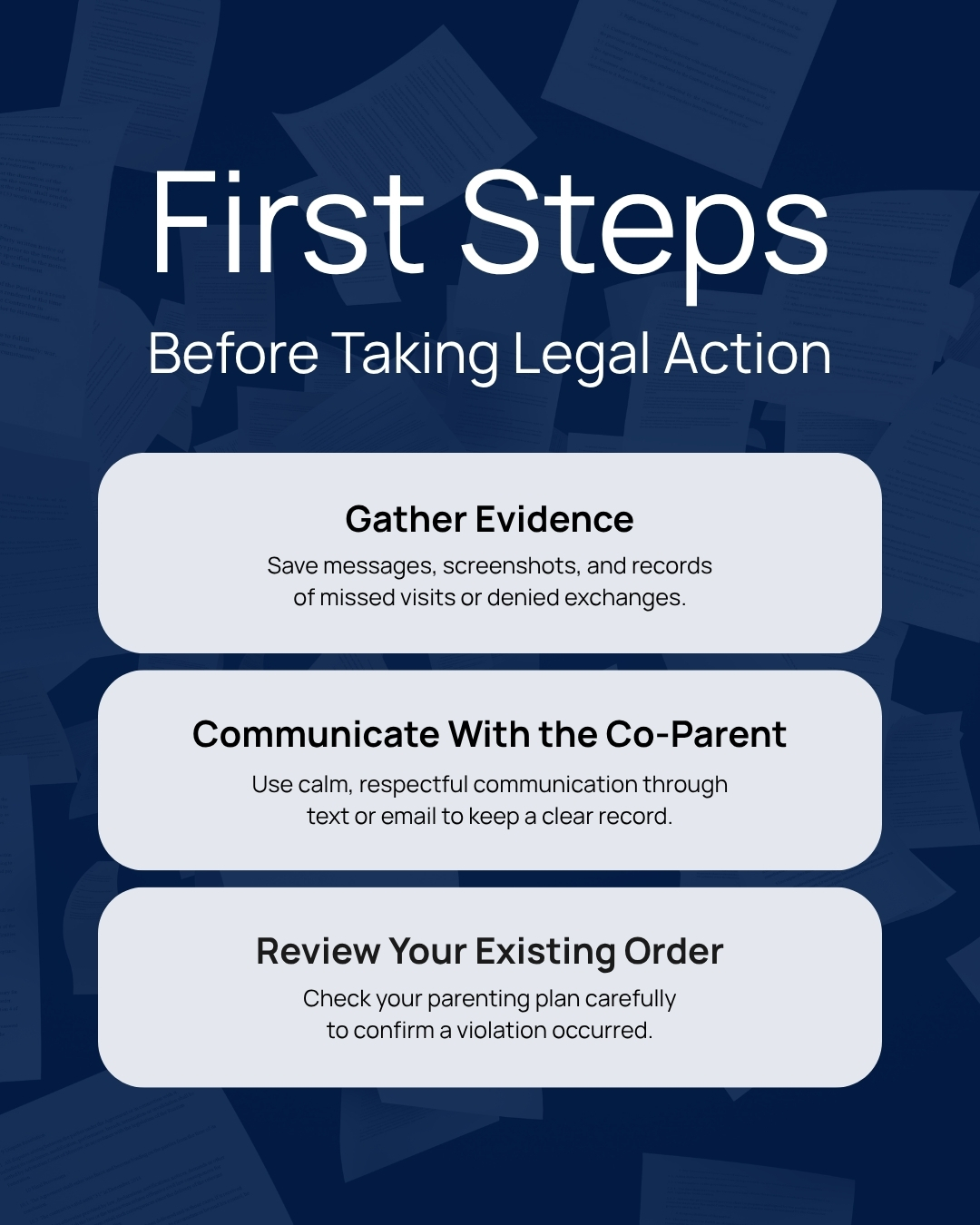
Gather Evidence
Evidence of a violation is required to enforce a parenting plan. Your attorney must provide evidence that a violation exists. This is especially true if the other parent denies your claims.
To gather strong support for a violation, it is important to carefully document every interaction with your child’s other parent. Keeping a record of missed or denied visits can demonstrate a pattern of the parent refusing to adhere to the court-ordered parenting plan and the need for enforcement to take place.
Communicate With the Co-Parent
Another important step before legal action becomes necessary is to be sure you are communicating clearly and calmly with the other parent. In certain situations, calm communication can help open a productive discussion in which both parents can agree on changes to the schedule or make-up visits. Be sure to limit all communication to text messages or emails; these easily recorded, time and date-stamped messages can help you demonstrate your attempts to amicably resolve the problem.
Review Your Existing Order
Carefully and thoroughly review your court order to ensure that the co-parent has truly violated the terms of the parenting plan. It is possible that miscommunication or misunderstandings can happen, and checking the terms of the parenting plan can reinforce that the parent’s actions were indeed a violation. If a violation occurred, notate the type of violation and organize evidence to support your case.
How to Document Parenting Time Violations
Documenting custody order violations in Arizona involves securing some crucial evidence:
Document Dates and Times
Record the dates and the times an exchange was missed or denied. Keep screenshots or copies of any digital evidence, such as text messages or voicemails, when the parent has restricted access to your child during a scheduled visitation.
If the violation involved a different type of refusal to adhere to the parenting plan, also note what was supposed to take place according to the parenting plan, as well as what actually occurred. Add notes describing how your child was impacted by the violation, such as missed events at school or emotional repercussions.
Witnesses and Third-Party Records
Witnesses and third-party records can be extremely helpful evidence. While witnesses are often family members, neighbors, or friends, law enforcement may also testify if they are called to the scene after an exchange is missed. The official police record of the incident can be presented to the court.
What Is Contempt of Court in Parenting Time Cases?
A parent may be found in contempt of court for willfully disobeying a court order or for purposefully disregarding a judge’s order, as outlined in ARS 25-414.

Contempt of court in a child custody order in AZ occurs when one parent knowingly and willfully violates the terms of a parenting plan. Please note that there must be an intention to willfully violate the court order. If the reason for violating the order involved ignorance, an emergency, or another valid reason, they may not be found in contempt of court.
Contempt can be a consequence when a parent fails to return their child to the other parent following a scheduled visit or refuses a visit without offering a credible reason. The burden of proof for violating parenting plans requires credible evidence that an existing court order was purposefully violated.
Remedies the Court May Order
If the court determines that one party has purposefully violated the terms of a court-ordered parenting plan, it can assess various remedies, including:
- Make-up Parenting Time – The court may schedule additional visitation time for the parent who previously missed visits with their child.
- Modification of Custody Orders – When serious violations have occurred or the violating parent continually refuses to obey the parenting plan, the existing court order may be modified under ARS 25-403.
- Fines or Sanctions – Civil penalties or fines of up to $100 per violation may be assessed for parenting time violations (ARS 25-414).
- Attorney’s Fees – Violating parents are often responsible for paying for the other parent’s attorney, as well as court costs.
- Possible Jail Time – Extreme cases may warrant time in jail for the offender.
What Is Make-Up Parenting Time?
Make-up parenting time in Arizona is time compensated to the parent who missed their scheduled visits with their child due to the co-parent’s refusal to comply with the parenting plan. This compensated time is court-ordered and typically part of an enforcement.
The court may grant make-up parenting time to a parent who has proven that their co-parent refused to follow the parenting plan and restricted visits with their child. Any additional visitation time is equivalent to the time lost, but it is only awarded for the best interests of the child.
When a violation occurs and the parent wishes to enforce the court-ordered parenting plan, a petition should be filed soon after the violation occurred. Under ARS 25-411, there may be restrictions on modifying a final order up to one year after it is created.
When Can Law Enforcement Get Involved?
If one parent knowingly and purposefully goes against the parenting plan and keeps a child from the co-parent, this is a crime known as custodial interference, as outlined under ARS 13-1302. Such violations can result in serious charges and may even result in a potential felony if the child is taken out of the state of Arizona. Police officers may become involved in these cases, most often to arrest the offending parent.

It is important to note that most cases involving civil custody orders do not require police involvement. However, law enforcement may assist when the parent has a copy of an existing court order and can prove that a violation has taken place. If there is an order of protection in place or a risk to the child’s safety, officers are more likely to get involved.
Escalating enforcement of a parenting plan violation is sometimes necessary for the safety of the child. If violations are continuous, deliberate, or threaten the safety of the child, an attorney may recommend a Petition of Contempt. If the co-parent has threatened to take the child or relocate them to another state, an emergency petition is a crucial first step.
When You Should Hire a Family Law Attorney
Consulting with a family law attorney is essential for handling violations of a parenting plan, especially when the following situations occur:
- Repeated Violations – If your child’s other parent is continually violating your existing court-ordered parenting plan, an attorney is essential to help you file a petition and secure make-up parenting time. You don’t have to handle it alone – schedule a consultation today.
- Co-parent Acting in Bad Faith – A family lawyer can help prove that a parent is acting in bad faith, which means that their actions are deliberate, untruthful, and willful.
- Need to File Contempt or Modify Orders – If you need to file for contempt or make modifications to custody orders, securing attorney help with the process is vital to securing a better outcome.
- High-Conflict Custody Situations – When custody orders are causing ongoing tension between you and your child’s other parent, consulting with a family lawyer can help you come to a mutual agreement.
How The Valley Law Group Can Help
Missing time with your child due to a co-parent’s refusal to follow a court order is extremely difficult to handle alone, especially when the behavior continues or escalates over time. Hiring an experienced family lawyer to take on your case can help you achieve the results you desire.
Filing Enforcement Actions
Enforcing a parenting plan requires documentation and filing petitions. An attorney can help you gather all necessary documentation and ensure your petition is filed correctly.
Building Strong Evidence
You must prove that a violation of an existing court-ordered parenting plan occurred to request enforcement of parenting time. A skilled child custody attorney can help you develop a strong case by gathering pertinent evidence.
Representing Your Interests and Protecting Your Rights
A lawyer serves as your representative in court, protecting your long-term custody rights while also negotiating for make-up parenting time or other avenues, if applicable.
Parenting Time Enforcement FAQs
Securing your court-ordered time with your child is of the utmost importance.
If your parenting time is threatened, The Valley Law Group is here to help answer your questions.
Secure the Support You Need for Your Parenting Time Enforcement Case
Securing legal representation as soon as possible after a violation has taken place is crucial, especially when it impacts your child’s safety. Taking swift legal action can prevent further violations from occurring, protecting your child’s best interests while also protecting your custody rights and preventing parental alienation. A skilled child custody attorney has the knowledge and experience necessary to pursue enforcement of your parenting rights in Arizona family court.
Don’t let parenting time violations continue.
Call The Valley Law Group today to protect your rights. We serve families across Phoenix, Gilbert, Scottsdale, and Peoria.

Sources:
- Arizona Revised Statutes § 13-1406. (n.d.). Sexual assault; classification; increased punishment. Retrieved April 6, 2026, from https://www.azleg.gov/ars/13/01406.htm
- Arizona Revised Statutes § 13-1404. (n.d.). Sexual abuse; classification. Retrieved April 6, 2026, from https://www.azleg.gov/ars/13/01404.htm
- Arizona Revised Statutes § 13-1402. (n.d.). Indecent exposure; classification. Retrieved April 6, 2026, from https://www.azleg.gov/ars/13/01402.htm
- Arizona Revised Statutes § 13-1405. (n.d.). Sexual conduct with a minor; classification. Retrieved April 6, 2026, from https://www.azleg.gov/ars/13/01405.htm
- Arizona Revised Statutes § 8-309. (n.d.). Child welfare and protection provisions. Retrieved April 6, 2026, from https://www.azleg.gov/ars/8/00309.htm
- Arizona Revised Statutes § 13-1425. (n.d.). Sexual exploitation of a minor; classification. Retrieved April 6, 2026, from https://www.azleg.gov/ars/13/01425.htm
- Arizona Revised Statutes § 13-1401. (n.d.). Definitions (sexual offenses). Retrieved April 6, 2026, from https://www.azleg.gov/ars/13/01401.htm
- Arizona Revised Statutes § 13-1418. (n.d.). Sexual assault kit tracking; victim rights. Retrieved April 6, 2026, from https://www.azleg.gov/ars/13/01418.htm
- Arizona Revised Statutes § 13-1410. (n.d.). Molestation of a child; classification. Retrieved April 6, 2026, from https://www.azleg.gov/ars/13/01410.htm
- Arizona Revised Statutes § 13-1419. (n.d.). Unlawful disclosure of images depicting states of nudity or sexual activity. Retrieved April 6, 2026, from https://www.azleg.gov/ars/13/01419.htm

Ryan Reppucci, Founder/Director of Legal Operations of The Valley Law Group, is recognized as one of Phoenix’s leading family law attorneys. After graduating from Arizona State with the highest honors and inclusion in America’s most prestigious student honor societies, Ryan attended the University of Detroit Mercy School of Law. His career as a law student was decorated with numerous awards, including the University of Detroit Mercy School of Law Book Award, nomination for membership in Who’s Who Among Students in American Colleges and Universities, as well as Moot Court.