



Going to court can feel intimidating, especially when your family’s future is on the line. It is common to feel anxious, and when you feel unprepared and out of the loop, this anxiety can grow exponentially. Knowing what to expect can make the experience far less stressful and empower you to present your case with confidence in your local branch of the Arizona family court.
What Is a Family Court Hearing?
Since there are numerous factors that can contribute to the confusing nature of the family court process, it can be easy to become overwhelmed. Family law is a vast arena, so to bring some clarity, it’s essential to define what a family court hearing is.
Simply put, a family court hearing is a formal proceeding where a judge will review evidence, listen to both sides, and make any temporary or permanent legal decisions, such as plans for parenting time or a strategy for paying child support. This enables both parties to present their ideas, preferences, and perceived needs equally, all the while establishing a workable plan for the family going forward.
The Types of Hearings You Might Attend
There are several different kinds of family court hearings that you may end up attending in Arizona, including the following examples:
Temporary Orders Hearing
Temporary orders hearings focus on establishing a short-term strategy for issues such as parenting time, housing, and child support. This serves as a temporary plan until the final one is issued by the judge, allowing you to continue living life and navigating family court hearings instead of putting your life on pause until you have your definite orders.
Resolution Management Conference
Resolution management conferences can be a helpful way of pursuing compromises and progress in your family’s legal case. This can be a useful tool for determining aspects of a divorce, such as property division, child support, parenting time, spousal support, custody, and more. These conferences are often carried out with the help of a non-partisan mediator whose goal is to help you and your spouse move forward with your divorce arrangements.
Related Reading: Divorce Litigation in Arizona: What to Expect in Court
Settlement Conference or Mediation
Similar to resolution management conferences, settlement or mediation conferences focus on helping both parties attempt to reach an agreement before needing to go to trial. While a judge will typically preside over settlement conferences, mediation sessions are generally carried out in private by a family lawyer. Depending on the complexity of the situation and the level of discord, different cases may require one or both of these hearings.
Trial (Evidentiary Hearing)
If your case goes to trial, it often means that you were unable to reach a compromise on all of the various aspects of your case, regardless of attending the previous types of hearings. Evidentiary hearings enable both parties to present their requests before a judge, pleading their case and offering evidence to back up their reasoning regarding issues like child support, parenting time, spousal support, and property division. The judge will make the ultimate decision on how the matters will be sorted, which must then be carried out by both parties, regardless of their preferences.
While these hearings differ in their methods, they all focus on accomplishing one goal: establishing a set of systems that will help you and your family move forward into this new future with the tools and strategies you need to thrive.
Before the Hearing: How to Prepare
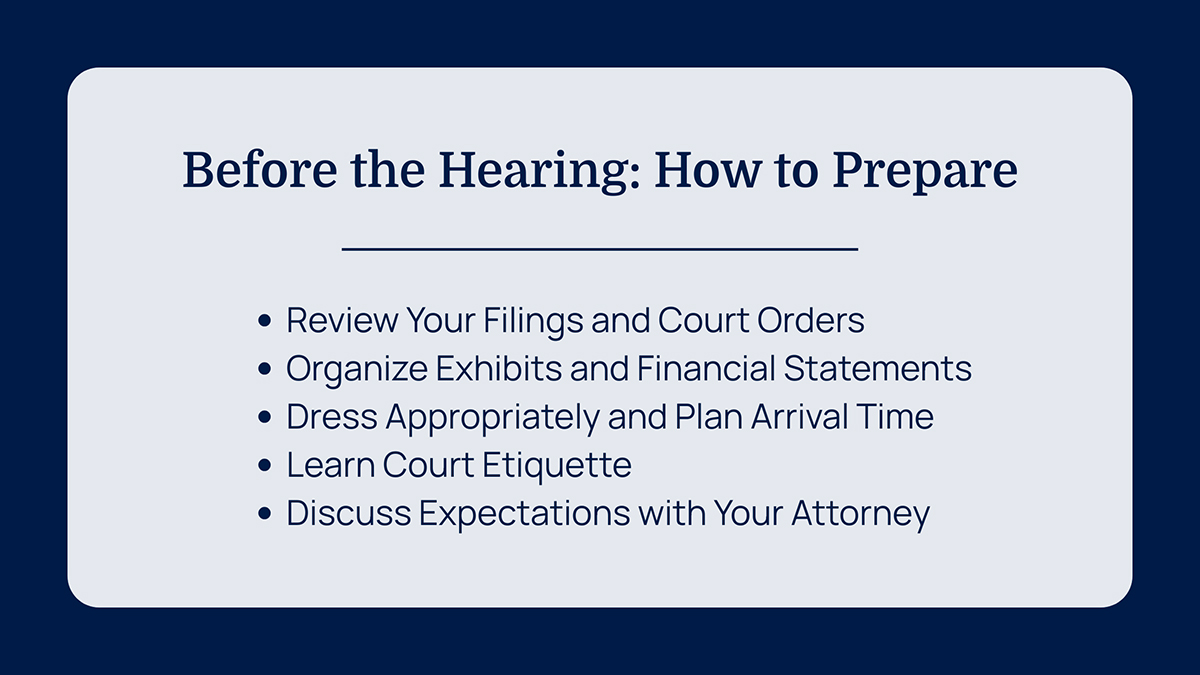
Preparing for a hearing is an incredibly important step toward achieving your future goals. There are several vital steps you should take prior to attending your hearing, including:
Review Your Filings and Court Orders
One of the best ways you can prepare your case is to make sure you are fully aware of any important and relevant documentation that may be referenced in your case.
This can include:
- Any financial affidavits or income statements, which can be used for alimony and/or child support decisions;
- Bank statements, tax returns, and/or pay stubs
- Logs of the communication that has occurred between you and the other party;
- Plans for parenting or custody agreements you and the other party have already arrived at, or that either party would like to propose;
- Previous court orders and/or plans; and
- Witness statements, character testimonies, and/or declarations.
Organize Exhibits and Financial Statements
While it may seem dramatic, your level of financial and evidentiary organizational skills can make or break your family’s legal case. Gathering evidence for your family hearing is one of the smartest things you can do for your case. It can help you and your attorney to reference important details and present your desired outcomes efficiently and succinctly, which makes you look well-informed and equipped.
Dress Appropriately and Plan Arrival Time
Dressing to impress is always a good idea when attending a family court hearing. It shows a level of professionalism and respect for the court, as well as your ability to care for yourself and deliver results. Arriving on time, or even early, is also helpful for presenting yourself well.
Learn Court Etiquette
This step may feel overwhelming, but it is something your lawyer can help you prepare for. The Arizona court system is a respected institution with protocol and etiquette that all who enter must uphold. Responding and interacting appropriately and respectfully can go a long way in showing who you are as a person and what you are willing to do to sort out your case.
Learn more: Courtroom Etiquette 101: Tips for Presenting Yourself Professionally
Discuss Expectations with Your Attorney
Similar to learning court etiquette, discussing your expectations with your attorney can help you get a realistic and relevant idea of what will happen at your trial and any additional steps you may need to take after it is complete. This will vary case by case, but it is something your lawyer can help you with.
What Happens in the Courtroom
Depending on the type of hearing you are attending, the protocol and individuals who are present may vary. Here’s what you can expect:
Who Will Be There?
- Judge – Unless it is a mediation session, there will typically be a judge present at your family hearing. It is their job to ensure that the legality and dignity of the court are upheld. If there are any children involved in the case, it is also their responsibility to ensure the safety, security, and welfare of the child trumps all other aspects of the case.
- Clerk – Clerks are a key part of documenting what happens at each hearing, as well as assisting in any additional administrative roles that may be required. They are a vital part of the family court process.
- Attorneys – Most divorcing couples secure their own attorneys. This allows each party to present their claims, requests, and evidence with the help of an advocate. The lawyer(s) can also help advise both individuals on how to craft and deliver their arguments and prepare them for navigating courtroom etiquette.
- Opposing Parties – For some, the presence of their opposing party may be a very difficult aspect of attending a hearing. It is, unfortunately, a common part of the family court process. However, with the help of your attorney, you may be able to avoid direct confrontation, which can bring some peace to your overall experience.
What Will Happen?
Attending a hearing can give you the chance to speak or testify on your own behalf, as well as explain why you think certain results may be the most beneficial for those involved. The judge may ask questions to clarify facts or evidence. If your attorney represents you, they can guide your presentation and handle any legal arguments. Fortunately, there are plenty of strategies you can use to successfully testify in family court.
How to Present Yourself Effectively
Though it may seem strange, how you present yourself can play a big role in the success of your case. Having the right demeanor, establishing credibility, and communicating clearly and respectfully can all go a long way in showing the court that you came prepared and ready to achieve results. Here are some specific examples of how you can exemplify this kind of commendable behavior.
Listen Carefully and Answer Only What Is Asked
You may feel tempted to sneak in answers or plead your case whenever you have been given the chance to speak. However, this can be perceived as disrespectful and unprofessional. Listen carefully, wait for your turn, and avoid giving answers that were not requested.
Avoid Reacting Emotionally
Even though this is likely a very emotional experience, the court is only interested in developing a logical strategy for the future of your family. Do your best to keep calm and respond carefully.
Speak Respectfully to the Judge and Opposing Counsel
The way you interact with everyone else in the room shows a great deal about how you handle difficult situations, disagreements, and respecting authority. While you may want to argue with your opposing party or question the judge’s decision, it is always better to approach your interactions with respect, decorum, and logic instead.
After the Hearing: What Comes Next

After your hearing, your judge may issue temporary orders or take the evidence presented in your case under advisement. Written orders generally follow, and then both parties will be required to comply with said orders until any modifications are issued.
When it comes to the duration of your case, there is unfortunately not a one-size-fits-all time that you can expect it to take. Different variables tend to influence your overall timeline, including the complexity of your case, whether or not additional hearings are needed, the schedule of your local courthouse, and the availability of all parties involved.
Still, having the help of a skilled and insightful lawyer can help you avoid unnecessary setbacks and unwanted mistakes, therefore keeping your case on track.
How an Experienced Attorney Helps
Having an attorney who knows the Maricopa County family court system can make your process and experience much smoother. From preparation to presentation, your lawyer can help you ensure that your evidence is clear, your deadlines are met, and your position is well-supported.
Family law attorneys can also help you protect your rights, deliver your case, and pursue your desired outcomes in a way that shows your true intentions and your ability to handle the changes that may result from these proceedings.
Get More Information Today

Preparing for your first family court hearing in Arizona?
Our experienced family law attorneys can help you understand what to expect and build a clear, confident strategy. At The Valley Law Group, we understand how stressful it can be for people to carry their cases alone, which is why we believe in tailoring our process to help all of our clients in their pursuit of a healthier, brighter future.
You do not need to face your family law hearing alone, and with our help, you can deliver a strong, effective, and clear case. Contact The Valley Law Group today for a free consultation, and see how we can help you and your family pursue the future you deserve.

Jonathan Roeder is a founding partner of The Valley Law Group and an Arizona attorney focused on family law, criminal defense, and personal injury. Jonathan has built his practice around helping clients navigate difficult legal issues with clear guidance, practical strategy, and strong advocacy. As an attorney, business owner, and Father of three, he understands the importance of preparation, communication, and helping clients make informed decisions during stressful and uncertain times. Jonathan’s career reflects both professional recognition and a commitment to developing others in the legal field. He has earned numerous legal honors, including recognition as a Super Lawyers Rising Star and a 10.0 “Superb” rating on Avvo, while also mentoring legal students and young attorneys through his work as a college faculty member and leader in his industry.