



A domestic violence misdemeanor in Arizona typically stems from violent physical acts or verbal threats towards a family relative or member of the household. This includes violent acts or threats toward a spouse or other domestic partner, child, sibling, parent, or any person who is closely related to the offender.
In Arizona, domestic violence may be charged as a misdemeanor or a felony. As these charges can have varying legal implications, it is essential to determine whether the court proceedings will occur in criminal or civil court. Many people assume that since domestic violence charges typically involve members of the same household, they are family court matters. In Arizona, however, domestic violence can also be charged as a criminal misdemeanor with legal consequences that may be life-altering.
What Is a Misdemeanor Domestic Violence Charge in Arizona?
Criminal acts can be charged as simple infractions, misdemeanors, or felonies. The most severe penalties, including prison time and heavy fines, are associated with felonies. However, misdemeanors can also result in a jail term, fines, court fees, and additional penalties. So, while misdemeanor domestic violence charges are not as severe as felony domestic violence charges, they must be taken seriously.
Domestic violence is not a standalone crime, but is instead a tag that is added to specific criminal acts committed against someone in a domestic relationship with the offender. This means that an individual is not typically charged with domestic violence alone. Instead, the offender is charged with a related crime, such as assault, threats, stalking, or disorderly conduct, as well as domestic violence.
A misdemeanor domestic violence charge must be associated with another misdemeanor. Class 1 misdemeanors that are often related to domestic violence charges include threats, endangerment, and intimidation. Class 2 misdemeanors can include criminal damage and certain kinds of assault. An example of a class 3 misdemeanor associated with a domestic violence charge may consist of a type of assault involving the intention to harm, insult, or provoke.
According to ARS 13-3601, a crime can be qualified as domestic violence under the following circumstances:
- The offender and the victim are married, in a domestic partnership, and living together, or have lived together at one time.
- The victim or offender became pregnant by the other party.
- The victim and the offender have a child.
- The victim is a relative of the offender in some way, such as a parent, grandparent, child, sibling, grandchild, brother-in-law, sister-in-law, step-parent, or stepchild.
- The victim of the crime is a child who lives in the home with the offender.
- The relationship between the victim and offender is romantic or sexual in nature. Authorities will consider the duration of the relationship, the extent of interactions between the victim and the offender, whether the relationship has ended, and if so, how long ago it ended.
Examples of Misdemeanor Domestic Violence Offenses
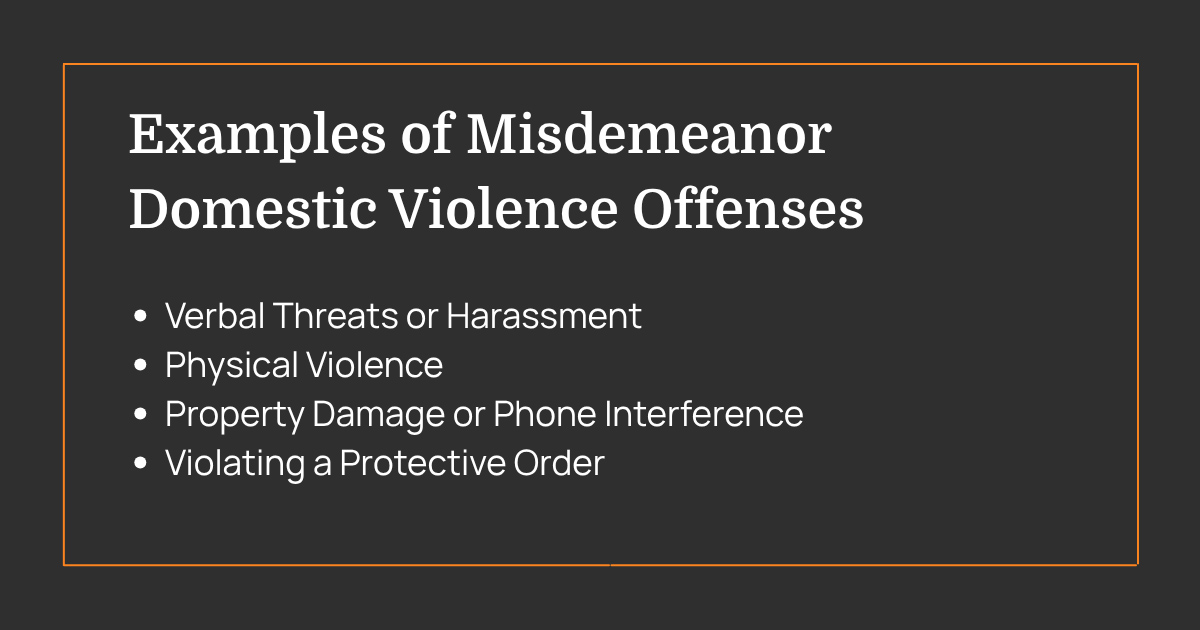
Misdemeanors associated with domestic violence usually involve violent actions toward a member of the family or a member of the household.
Below are a few examples of misdemeanor domestic violence in Arizona:
Verbal Threats or Harassment
Persistent verbal threats or verbal harassment are often known as verbal abuse. The perpetrator may use harsh language as a way to control, belittle, threaten, or intimidate another person. Instances of threatening, intimidating, name-calling, or verbally attacking someone else can result in harassment charges.
Physical Violence
Physically violent actions against another person that may result in misdemeanor charges include shoving, slapping, choking, and punching. If the alleged abuse is serious, the accused individual may face charges of domestic assault in Arizona.
Property Damage or Phone Interference
Causing damage to another person’s property during a domestic dispute can result in a criminal damage charge as well as a domestic violence charge. Similarly, if the perpetrator interferes with an individual’s ability to use their phone after a dispute, it may be considered Preventing the Use of a Telephone in an Emergency, which is a violation of ARS 13-2915.
Violating a Protective Order
Protective orders prohibit contact between a perpetrator and a victim, and any contact initiated by the perpetrator can be charged as a violation of the protective order. Protective order violations may be classified as a felony or a misdemeanor depending on the severity of the violation.Violations of a protective order that involve physical assault or stalking are typically charged as felonies, but any other contact can result in misdemeanor charges.
Penalties for Domestic Violence Misdemeanors in Arizona
Arizona courts assess various penalties for domestic violence charges, a decision that is dependent on several factors.
Factors that can increase or decrease the severity of associated penalties include:
- Whether the victim was a child
- Whether the victim sustained injuries or was killed
- Whether the victim was pregnant when the incident occurred
- Whether a weapon was used
- Whether the offender has previous domestic violence convictions
Depending on the circumstances, misdemeanor domestic violence charges are typically charged as class 1, 2, or 3 misdemeanors in Arizona. First-offense domestic violence charges or charges without physical violence may be charged as a less-severe class 3 misdemeanor, while subsequent domestic violence charges involving physical assault may be charged as class 1 or 2. Penalties for the three classes of misdemeanors increase along with the severity of the crime.
Penalties may include the following:
Jail or Prison Time and Fines
The most common penalties for domestic violence involve time in jail or prison and monetary fines.
- Class 1: Results in penalties involving six months in prison and/or fines up to $2,500
- Class 2: Penalties include a four-month prison sentence and/or fines up to $750
- Class 3: Penalties include 30 days in prison and/or fines up to $500
Rarely, domestic violence may be charged as a petty misdemeanor. This does not generally involve a prison sentence but does incur a fine of up to $300.
Probation
In addition to jail time and fines, people charged with domestic violence may also need to complete a probation sentence. During probation, the offender will need to provide drug tests at random, keep a stable job and place of residence, adhere to a curfew, and seek drug/alcohol treatment. Community service hours may also be required to complete as a consequence of a domestic violence charge and, in some cases, complete mandatory domestic violence counseling or treatment.
Domestic Violence Counseling
Most offenders convicted of misdemeanor domestic violence will be required to attend counseling and education regarding this offense at their own cost. Counseling may be mandatory for first-offense domestic violence offenders. The court will determine whether counseling is appropriate for subsequent offenses.
Restrictions Stemming from Orders of Protection
According to ARS 13-3602, an Order of Protection can be granted by a judge as a way to protect the victim and family members from the offender. These orders keep the offender from being allowed anywhere near the victim’s place of work, school, or place of residence. A protective order may also prevent them from communicating with the victim in any way.
Certain protection orders can include firearm restrictions if the offender has been discovered to be a threat to the victim or to others. If the offender owns firearms, they may be required to hand them over to law enforcement.
Other Long-Term Consequences
Long-term consequences may also result from a domestic violence misdemeanor conviction. Having such a conviction can make it difficult to secure housing and limit employment opportunities. Convictions may also lead to restrictions regarding child visitation rights.
Don’t risk facing lifelong implications due to a misdemeanor charge. Contact The Valley Law Group to begin exploring your defense options.
How Domestic Violence Charges Differ from Family Court Cases

Many Arizonans mistakenly believe that cases involving domestic violence are solely handled as family law cases in family court. In reality, while some aspects of domestic violence charges do pertain to family court, criminal domestic violence charges are handled in criminal court with the potential penalty of a prison sentence and/or fines. The goal of these proceedings is to hold the guilty party responsible for their criminal acts.
Criminal domestic violence charges may then affect an individual’s family court case or trigger new family court proceedings. Domestic violence can necessitate changes to parenting time agreements, other matters of child custody, or divorce proceedings. Domestic violence charges can also necessitate orders of protection. However, the family court does not handle criminal charges.
In many situations, both civil and criminal proceedings occur simultaneously. However, each requires a unique legal response tailored to the case at hand. If you are the victim of domestic abuse and need an Order of Protection or an Injunction Against Harassment, a family lawyer can assist you in filing the order. If you are accused of domestic violence or violating a protective order, you will need the assistance of a criminal defense lawyer.
What to Do If You’ve Been Charged
If you have been charged with a domestic violence misdemeanor, it is important to understand your rights and follow some crucial recommendations.
- If you are arrested, invoke your right to remain silent. Remember: anything you say could be held against you in court.
- If your case involves an Order of Protection, do not violate the order by attempting to contact the alleged victim. Even contact through a third party is considered a violation and may lead to additional criminal charges, hindering your case.
- Consult with a criminal defense attorney who has experience with criminal defense for DV. An attorney can help you gather helpful evidence to support your case, review the charges against you, and develop a personalized defense strategy.
It is essential to seek legal counsel as soon as possible after discovering an allegation of domestic violence against you. Doing so can result in reduced charges, diversion, or even dismissal of your case. The Valley Law Group boasts a dedicated team of attorneys to help you navigate these charges. Schedule a free consultation with our criminal defense team today.
Domestic Violence Charges Frequently Asked Questions
The Valley Law Group takes pride in helping clients navigate domestic violence situations. Our attorneys have compiled some of the most common domestic violence charge questions.
Why Choose The Valley Law Group?

Facing a domestic violence misdemeanor charge can be both stressful and overwhelming, and the situation should not be handled alone. It is vital to have a skilled attorney on your side who has expertise in criminal defense as well as family law. An attorney’s ability to build a strategic defense strategy is key to your case’s success.
As soon as you reach out to us, The Valley Law Group’s skilled team of criminal defense attorneys can protect your future by advocating for your rights and freedoms. We are fully prepared to assess the circumstances of your case to develop a strong legal defense.
Our team is available 24/7 for those with urgent arrests or arraignments. No matter your location, you can book a consultation at our offices in Phoenix, Gilbert, Peoria, and Scottsdale, handled by managing attorney Jon McCarty, in Central/West Valley.
Finding a Domestic Abuse Defense Attorney in Arizona
A domestic violence misdemeanor must be taken seriously as it is a criminal charge with long-term consequences. Don’t wait to contact an attorney to protect your rights. The Valley Law Group offers free consultations– call now to schedule yours.
Sources:
- Arizona Revised Statutes § 13-2915. (n.d.). Preventing use of a telephone to harass; penalty. Retrieved March 31, 2025, from https://www.azleg.gov/ars/13/02915.htm
- Arizona Revised Statutes § 13-3602. (n.d.). Order of protection; procedure; contents; arrest for violation; penalty; protection order. Retrieved March 31, 2025, from https://www.azleg.gov/viewdocument/?docName=https://www.azleg.gov/ars/13/03602.htm
- City of Phoenix. (n.d.). Court Programs – Protection Orders. Retrieved March 31, 2025, from https://www.phoenix.gov/administration/departments/court/court-programs/protection-orders.html
- U.S. Department of Justice. (n.d.). Criminal Resource Manual § 1117: Restrictions on the Possession of Firearms by Individuals Convicted of a Misdemeanor Crime of Domestic Violence. Retrieved March 31, 2025, from https://www.justice.gov/archives/jm/criminal-resource-manual-1117-restrictions-possession-firearms-individuals-convicted
- Arizona Revised Statutes § 13-3601. (n.d.). Domestic violence; definition; classification; sentencing option. Retrieved March 31, 2025, from https://www.azleg.gov/ars/13/03601.htm

Jon McCarty has broad experience in a wide variety of criminal defense and family law matters. After graduating from the University of Illinois College of Law with the highest honors, Jon served as Law Clerk to The Honorable David Briones in the United States District Court for the Western District of Texas. After running a successful practice of his own for many years, Jon relocated to Maricopa County where he has continued to strive for excellence through aggressive yet compassionate representation of each client. Jon has been named to the list of Super Lawyers in the area of family law multiple times, and has been recognized for his outstanding commitment to Equal Access to Justice through providing pro bono representation to numerous clients.