



Drug trafficking laws in Arizona are some of the strictest in the country, and a conviction can lead to years in prison, steep fines, and a permanent felony record. Many people assume trafficking charges only apply to large criminal operations or drugs crossing the border. In reality, Arizona prosecutors can file trafficking charges in cases involving relatively small amounts of drugs, depending on the intent of the person in possession of them.
These cases move quickly and often carry serious consequences from the start. Felony drug charges in Arizona may involve mandatory prison time, asset forfeiture, and long-term damage to employment and housing opportunities. If you’ve been arrested, understanding your charges and getting immediate legal guidance can make a major difference in the outcome of your case. The Valley Law Group represents clients facing serious Arizona drug crime charges, including allegations involving possession for sale, transportation, distribution, and related felony offenses.
What Is Drug Trafficking Under Arizona Law?
Arizona’s drug trafficking laws are outlined in Arizona Revised Statutes § 13-3407 and A.R.S. § 13-3408. While the state does not have one singular statute for drug trafficking, these laws outline prohibited conduct and classifications that form the basis for trafficking-related charges in the state.
The laws cover several forms of conduct, including:
- Possession of drugs for sale
- Transportation of controlled substances within, into, and out of the state, not just when crossing borders
- Sale or attempted sale of drugs
- Distribution or delivery of controlled substances
Together, these statutes are the foundation for prosecutors when filing charges for drug crimes in the state. Keep in mind, the exact charges you may face depend on the facts and circumstances involved.
Types of Drug Trafficking Charges
Under Arizona’s drug trafficking laws, prosecutors can pursue several different felony charges depending on the alleged conduct and available evidence. Charges are often based on the theory that drugs were intended for sale, movement, or distribution rather than personal use.
Common drug trafficking-related charges include:
- Possession of Drugs for Sale – For drug possession for sale, Arizona law considers the amount of drugs in a person’s possession and any evidence of packaging or sales activity.
- Transportation of Controlled Substances – This charge involves moving illegal drugs from one location to another, although it does not require the drugs to cross state lines.
- Sale or Attempted Sale of Illegal Drugs – This charge is based on allegations that the drugs were exchanged or offered for money.
- Distribution of a Controlled Substance – Drug distribution charges in AZ cover handing off, supplying, or facilitating drugs for another person.
- Manufacturing Illegal Drugs – This applies to creating, processing, or preparing controlled substances.
Common Drugs Involved in Trafficking Charges
Drug trafficking laws in Arizona apply to a wide range of controlled substances, and cases are often driven by the type and quantity of the drugs involved. Even substances that are commonly known or widely used can lead to serious felony charges when the intent to sell, transport, or distribute is present.
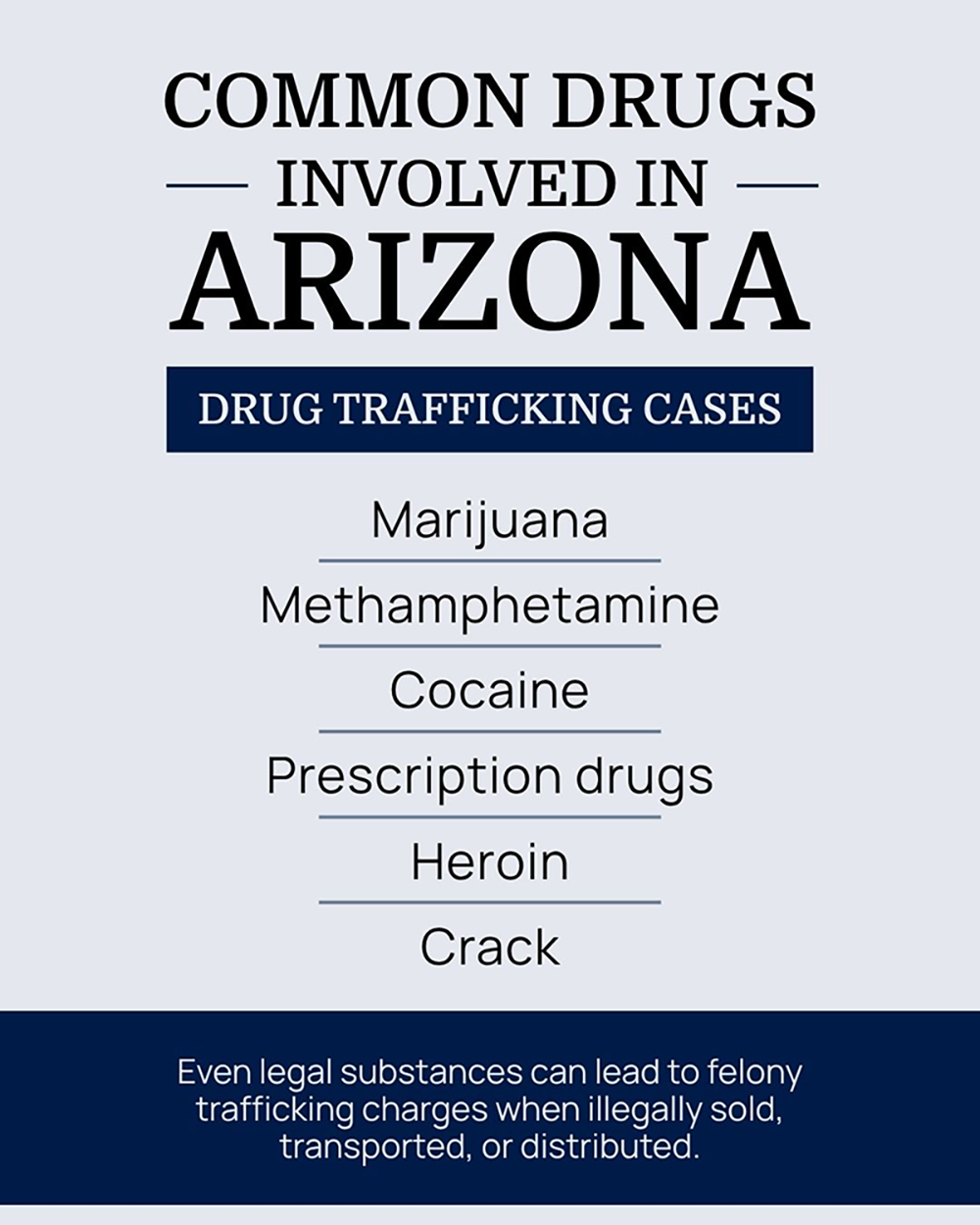
According to the Arizona Department of Public Safety (2024), law enforcement in the state seized 6,498 pounds of illicit drugs in just a single three-month period in 2024.
Common drugs that lead to trafficking charges include:
- Marijuana
- Methamphetamine
- Cocaine
- Prescription drugs
- Heroin
- Crack
Although adult-use marijuana is legal in Arizona under specific limits, marijuana-related conduct can still lead to criminal charges when it involves unlawful possession amounts, unauthorized sale, transportation for sale, or distribution outside the state’s legal framework. Prescription medications can also lead to serious charges when they are unlawfully possessed, sold, transported, or distributed.
The substances listed above and many others are often central to prosecutors’ cases, and even small quantities can escalate into major felonies.
How Drug Quantity Affects Arizona Drug Trafficking Charges
The amount of drugs involved can play a major role in how Arizona prosecutors file and pursue trafficking-related charges. Arizona law uses statutory threshold amounts for certain controlled substances, meaning the type and weight of the substance can affect the seriousness of the case, potential penalties, and whether probation may be available.
Threshold amounts vary by substance, so there is no one-size-fits-all rule. For example, the legal analysis may change depending on whether the case involves methamphetamine, cocaine, heroin, fentanyl, prescription drugs, marijuana, or another controlled substance. Prosecutors may also look at the amount alongside other evidence, such as packaging, cash, messages, scales, or alleged transportation activity.
Because drug quantity can affect both the charge and the defense strategy, anyone facing allegations involving possession for sale, transportation, sale, or distribution should speak with an Arizona criminal defense attorney as soon as possible.
Arizona Drug Trafficking Penalties
Drug trafficking-related penalties in Arizona depend on the substance, conduct, amount, prior record, and whether statutory threshold amounts or special sentencing rules apply. Many sale, transfer, transport-for-sale, and possession-for-sale offenses are Class 2 felonies, but some manufacturing, fraud, equipment, or lower-level possession-related offenses may be charged differently.
General felony sentencing ranges and fines are addressed under A.R.S. § 13-702 and A.R.S. § 13-801, but drug-specific statutes such as A.R.S. § 13-3407 and A.R.S. § 13-3408 may also include specific classifications, sentencing rules, and exceptions depending on the substance and alleged conduct.
- Class 2 Felony – Conviction of a class 2 felony, typically the most severe conviction for a drug trafficking charge, can carry a prison sentence of three to 12.5 years and a fine of up to $150,000.
- Class 3 Felony – This charge comes with a potential prison sentence of 2 to 8.75 years and a fine of up to $150,000.
- Class 4 Felony – As the lower-level charge for drug trafficking, conviction comes with a prison sentence of 1 to 3.75 years and a fine of up to $150,000.
It’s important to note that there could be more severe penalties for prior offenses or if aggravating circumstances apply. What’s more, there are other long-term penalties and consequences, including difficulty getting professional licenses, applying for housing, problems with employment, and strained relationships.
For a broader breakdown of sentencing exposure, related felony classifications, and collateral consequences, review our guide to penalties for drug crimes in Arizona.
What Prosecutors Look For
With 6,306 drug crime convictions in fiscal year 2024, according to the Arizona Criminal Justice Commission (2024), it’s important to know what prosecutors are looking for in these cases. Drug trafficking cases are often built on various forms of evidence that prosecutors use to argue intent to sell or distribute a controlled substance. Even without a direct sale, certain factors can significantly influence how charges are filed.
Prosecutors evaluate:
- Quantity of drugs
- Packaging materials
- Cash or financial evidence
- Communication, such as calls and texts
- Location and context of arrest
These factors often combine to form the basis of the prosecution’s case.
Attorney Insight:
Drug trafficking cases are often built on assumptions about intent. The presence of drugs alone does not always prove sale, transportation for sale, or distribution. A strong defense often starts by examining how the evidence was found, whether the search was lawful, and whether prosecutors can actually prove the intent behind the alleged possession.
Possible Defenses to Drug Trafficking Charges
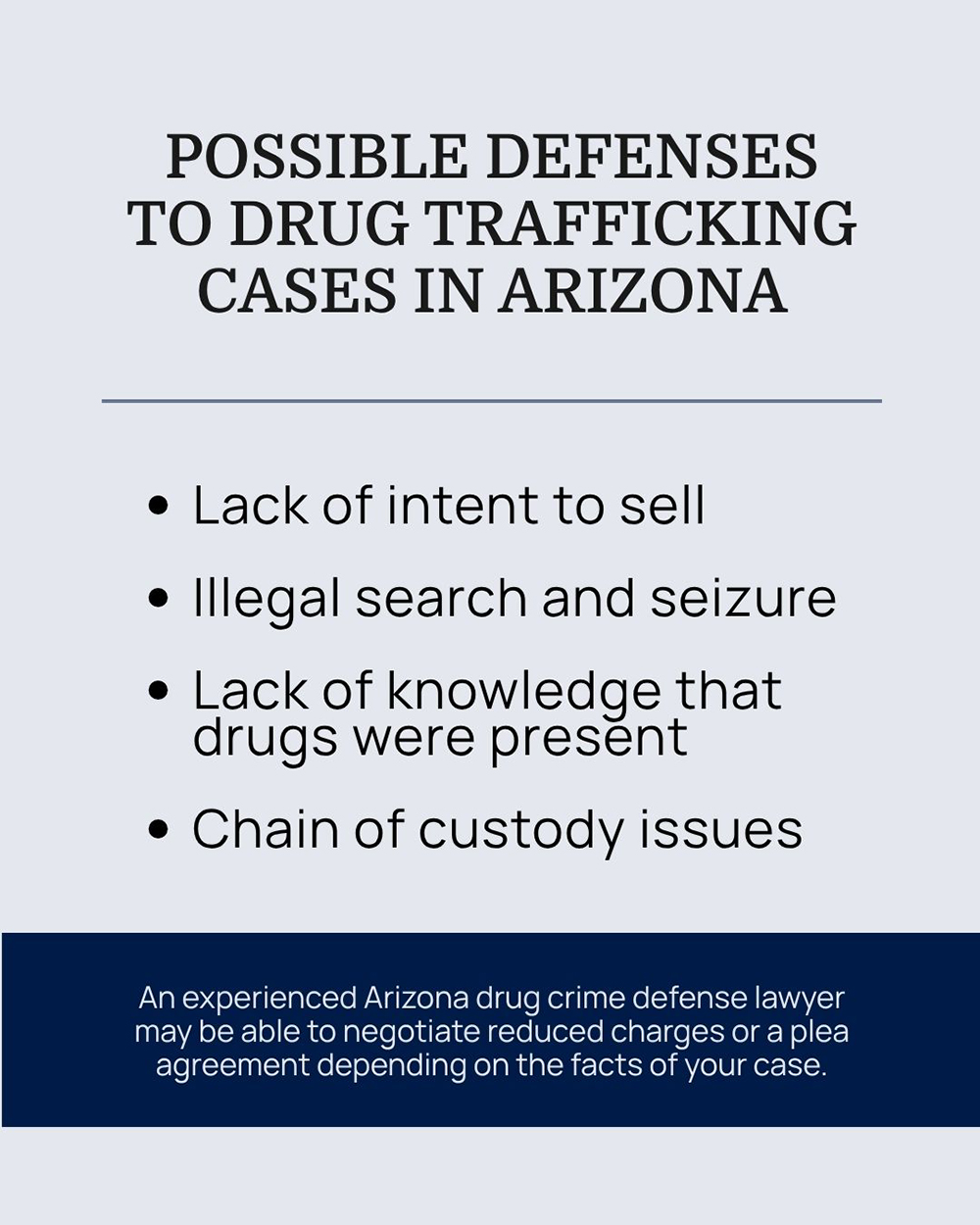
Defense strategies in drug trafficking cases often focus on challenging the prosecution’s evidence of intent, possession, and legality of the investigation. Because many of these cases rely on circumstantial proof, the right defense approach can be the difference between acquittal, a plea bargain, or conviction.
Defense strategies include:
- Lack of intent to sell
- Illegal search and seizure
- Lack of knowledge that drugs were present
- Chain of custody issues
If the circumstances call for it, your Arizona drug crime defense lawyer may negotiate with prosecutors to reach a plea agreement, where you plead guilty to a lower-level offense in exchange for a reduced sentence.
Why These Charges Are Often Overfiled
In some Arizona drug cases, prosecutors may initially file more serious charges based on early indicators such as quantity, packaging, cash, or alleged communications. However, those initial allegations do not always tell the full story. In many cases, the defense may be able to challenge whether the evidence actually supports possession for sale, transportation for sale, or distribution.
One common reason cases are filed is that law enforcement bases its assumptions on the quantity of the drugs present. Larger amounts of drugs are often automatically treated as an intent to sell, even when the context is unclear. Prosecutors also have broad discretion in charging decisions, which can lead to elevated charges.
However, these charges are not always static. With a strong defense, they may be reduced or reclassified, particularly when evidence of intent is weak or illegally obtained. This makes early legal intervention critical in drug trafficking cases.
What To Do if You’re Facing Drug Trafficking Charges
If you’re accused of drug trafficking in Arizona, what you do immediately after your arrest can significantly impact your case. These cases move quickly, and you could make a mistake that affects the outcome.
Follow these steps if you are facing drug trafficking charges.
- Do not speak to the police without an attorney present – Anything you say to investigators can be used against you, even if you think you’re just offering an explanation or denying involvement. There’s no talking your way out of it.
- Avoid discussing the case with anyone besides your lawyer – Conversations with friends or family can come back to haunt you in court. Even posts on social media may not be safe from prosecutors.
- Contact a criminal defense attorney immediately – Working with an experienced Arizona criminal defense attorney early can help protect your rights, challenge evidence, and address potential issues before the case progresses.
Drug trafficking charges carry serious consequences. Get experienced legal defense now.
Drug Trafficking Charges FAQs
If you or a loved one is facing drug trafficking charges in Arizona, it’s natural to have questions about what to expect. We’ve answered a few frequently asked questions below.
How The Valley Law Group Can Help
When you’re facing drug trafficking charges, having an experienced criminal defense attorney on your side can make a critical difference in the outcome of your case. The Valley Law Group builds defense strategies focused on challenging the prosecution’s evidence and protecting clients from violations of their rights.
Our team conducts a detailed review of the evidence to identify weaknesses in the state’s case, including issues related to intent, possession, and search procedures. We also challenge the charges themselves when the evidence doesn’t support the level of the allegations.
From negotiating with prosecutors to seeking reductions or dismissals, we work to limit your exposure. If necessary, we aren’t afraid to take your case to trial and aggressively defend you before a judge and jury.
Contact Our Arizona Drug Trafficking Defense Law Firm
Drug trafficking charges are among the most serious criminal cases in the state, and they can escalate quickly based on quantity, intent, and how evidence is interpreted. Even first-time accusations can lead to severe consequences under state law, including prison time, expensive fines, and long-term damage to your reputation.
Because these cases often rely on circumstantial evidence, early legal representation is key. The sooner a defense attorney can review the case, the better the chances of reducing or successfully challenging the charges.
Facing drug trafficking charges in Arizona? Call The Valley Law Group now for immediate help. We’re available 24/7 across Arizona with offices in Phoenix, Scottsdale, Gilbert, and Peoria.
Sources:
- Arizona Criminal Justice Commission. (2024). Arizona drug and crime report: EDGE report. https://azmemory.azlibrary.gov/assets/displaypdf/326392
- Arizona Department of Public Safety. (2024). Troopers seize nearly 6,500 pounds of illicit drugs in three-month period. https://www.azdps.gov/news/releases/1059
- Arizona Legislature. (2025). Arizona Revised Statutes § 13-3401. https://www.azleg.gov/ars/13/03401.htm
- Arizona Legislature. (2025). Arizona Revised Statutes § 13-3405. https://www.azleg.gov/ars/13/03405.htm
- Arizona Legislature. (2025). Arizona Revised Statutes § 13-3407. https://www.azleg.gov/ars/13/03407.htm
- Arizona Legislature. (2025). Arizona Revised Statutes § 13-3408. https://www.azleg.gov/ars/13/03408.htm
- Arizona Legislature. (2025). Arizona Revised Statutes § 13-702. https://www.azleg.gov/ars/13/00702.htm
- Arizona Legislature. (2025). Arizona Revised Statutes § 13-801. https://www.azleg.gov/ars/13/00801.htm

Jon McCarty has broad experience in a wide variety of criminal defense and family law matters. After graduating from the University of Illinois College of Law with the highest honors, Jon served as Law Clerk to The Honorable David Briones in the United States District Court for the Western District of Texas. After running a successful practice of his own for many years, Jon relocated to Maricopa County where he has continued to strive for excellence through aggressive yet compassionate representation of each client. Jon has been named to the list of Super Lawyers in the area of family law multiple times, and has been recognized for his outstanding commitment to Equal Access to Justice through providing pro bono representation to numerous clients.