


The prospect of divorce can seem daunting and complicated, and each state has its own regulations. Valley-area residents considering divorce can begin by learning how to get a divorce in Arizona. Consult The Valley Law Group’s step-by-step guide to divorce in Arizona.
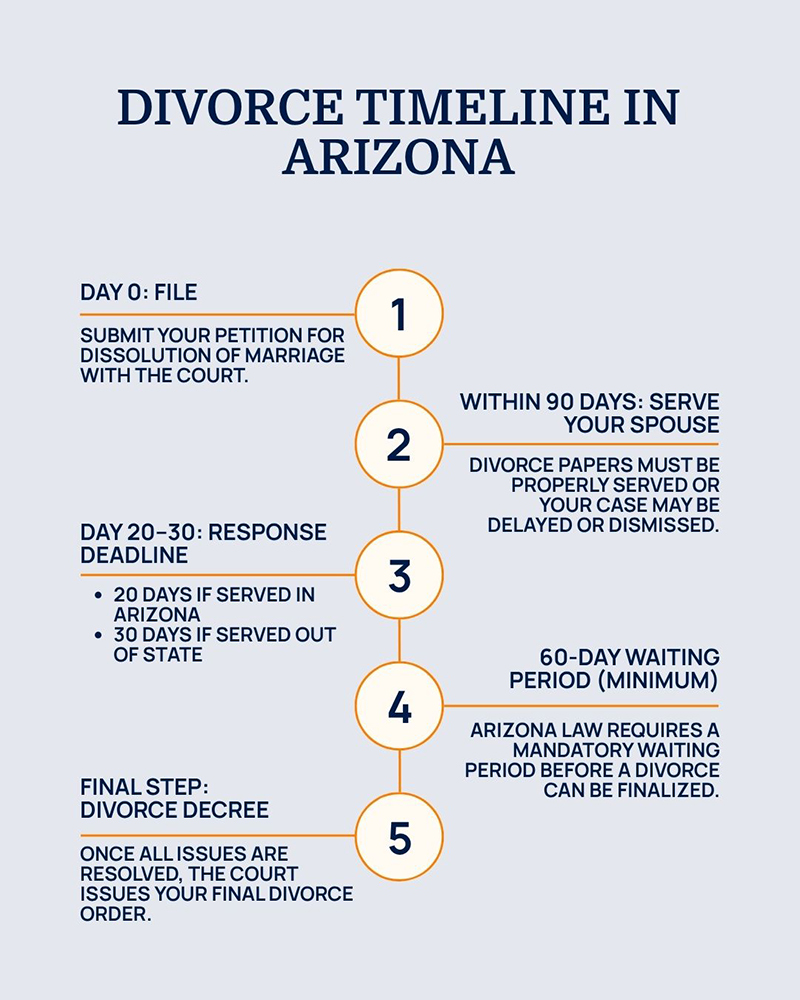
The basic steps that outline how to file for divorce in AZ include meeting Arizona’s residency requirements, filing your divorce petition, serving your spouse, reaching an agreement on divorce terms, and receiving a final divorce decree after the mandatory waiting period.
Step 1: Meet Arizona’s Residency Requirements
To begin the divorce process in Arizona, you must meet the residency requirements for Arizona’s family court to secure jurisdiction over your case. According to Arizona Revised Statutes 25-312, at the time a divorce proceeding is initiated, at least one of the spouses must reside in Arizona, and must have resided in the state for the 90 days prior to the filing. If a person is in the military and stationed in Arizona for at least 90 days, this requirement is satisfied.
When you file for divorce in Arizona, you must file your initial petition in the county where you live.
You must also ensure you meet these residency requirements to file for divorce in Arizona:
- At least one of the parties must have resided in Arizona for 90 days prior to the filing.
- The petition must be filed in the filing spouse’s county of residence, assuming that person has lived in Arizona for 90 days.
- The residency requirement is satisfied for military members who have been stationed in Arizona for 90 days prior to the filing.
Step 2: File a Petition for Dissolution of Marriage

To begin a divorce proceeding, the petitioning spouse must file the initial petition for divorce. This is a multi-step process that requires several forms and varies depending on whether the divorcing couple has children.
Where Do I File the Petition?
The petition for dissolution of marriage must be filed with the Clerk of the Superior Court in the petitioner’s county of residence. If the petitioning spouse does not meet the Arizona residency requirements, the petition may not be processed by the court. Therefore, if you and your spouse are considering divorce and one of you has lived in Arizona for 90 days while the other has not, the person who has lived in the state for 90 days should be the petitioning spouse.
What Forms Do I Need?
You must complete several forms to file for a divorce in Arizona.
Generally, when you submit your initial petition, you need the following documents:
- Petition for Dissolution of Marriage – This is the actual divorce petition form where you fill in information about your marriage, your community property, your debts, spousal and child support, and other aspects of marriage that must be addressed when getting divorced.
- Notice of Right to Convert Health Insurance – This document explains procedures for securing health insurance for you and your children following divorce.
- Affidavit Regarding Minor Children – If you and your spouse have children, you will need to fill out this form with their information.
- Order and Notice Regarding the Parent Information/Education Program – This form is a notice of a mandatory parenting class in Arizona. It is necessary if either party in a divorce has requested that the court intervene in parenting time or decision-making arrangements.
- Notice Regarding Creditors – This document states that both spouses are jointly and severally liable for community debts and should be included in a divorce papers packet.
What Are the Filing Costs?
The fee to file an initial divorce petition is governed by Arizona Revised Statutes 12-284. The filing fee for a divorce is $149.
What if There Are No Children?
If the divorcing couple does not have any children, the procedure and forms are essentially the same. However, there is no need for the section of the divorce petition regarding minor children. In addition, there is no need for the Affidavit Regarding Minor Children to be included with the filing.
Step 3: Serve Your Spouse
The next step in the divorce process is to serve your spouse with divorce papers. The simplest way is to do so yourself, but many individuals choose to have their spouses served by a third party. Regardless of your choice, the receipt of the papers must be formally acknowledged by your soon-to-be-ex.
According to the Superior Court of Arizona, there are several acceptable ways to serve divorce papers, including:
- Acceptance of Service – If your spouse is willing to sign the Acceptance of Service form acknowledging that they received the divorce papers, you can simply deliver them yourself.
- Mail – You can send the papers by mail if your spouse is willing to sign for them upon arrival.
- Registered Process Server – A process server registered with the court system can hand-deliver the papers to your spouse for a fee.
- Sheriff – You can pay a fee to have the sheriff in the county where your spouse lives hand-deliver the papers.
Publication or Other Alternative – Sometimes, it is difficult to locate the receiving spouse. In these cases, a court may grant permission to publish the notice in a local newspaper.
Need Help Navigating the Divorce Process?
From filing to final decree, our Arizona divorce resources break down each step so you know exactly what to expect.
What If My Spouse Refuses Service?
If your spouse refuses to accept divorce papers, this does not mean your divorce cannot proceed. In cases of refusal, you can ask the court to allow you to serve your spouse through publication or another alternative method. This allows the legal service requirement to be satisfied even if your spouse will not cooperate. Keep careful records of your attempts to serve your spouse in case you need to pursue a default judgment later in the process.
Step 4: Response and Waiting Period
After you file your initial petition for divorce, your spouse has an opportunity to respond to the petition. The length of time your spouse has to respond depends on the method of service and whether your spouse lives in Arizona or in another state.
- 20 days – All service methods other than publication for respondents who live in the state
- 30 days – All service methods other than publication for respondents living out of state
- 50 days – Service by publication for in-state respondents
- 60 days – Service by publication for out-of-state respondents
What Is the Mandatory Waiting Period in Arizona?
All divorces in Arizona are subject to a 60-day waiting period from the date of the initial filing. This mandatory waiting period is the minimum time from the beginning of the proceeding to the issuance of the final divorce decree. It is important to note that the vast majority of divorces take more than 60 days to finalize.
What if No Response is Filed?
If your spouse refuses service or otherwise does not file a response to the divorce petition within the allotted time, your divorce can proceed with a default hearing. In this proceeding, you can bring your divorce documents to court, and a judge can issue a divorce decree and any relevant orders without the participation of your spouse. Default judgments often result in the court granting the petitioner most of their requested terms.
Considering divorce?
Schedule a confidential consultation with our Arizona divorce attorneys today.
Contested vs. Uncontested Divorce in Arizona
Divorces in Arizona generally fall into two categories: contested and uncontested. The difference depends on whether both spouses agree on the terms of the divorce.
Uncontested Divorce
An uncontested divorce occurs when both spouses agree that the marriage should end and are able to reach an agreement on all major issues, including property division, spousal support, and parenting arrangements.
Because there are no disputes to resolve, uncontested divorces are typically faster, less expensive, and less stressful. In many cases, the divorce can be finalized shortly after Arizona’s mandatory waiting period.
Contested Divorce
A contested divorce occurs when spouses cannot agree on one or more key issues, or when one spouse does not want the divorce at all.
In these cases, the court may need to step in to resolve disputes related to property, finances, or child custody. This process can involve mediation, negotiations, and multiple court hearings.
Contested divorces often take longer to resolve and can be more costly due to the additional legal steps involved. They can also be more emotionally complex, especially when conflict between spouses escalates during the process.
How Long Does a Divorce Take in Arizona?
As indicated, divorce timelines can vary widely in Arizona, as the time to settle a case depends heavily on the circumstances. The minimum waiting period for a divorce to be finalized in Arizona is 60 days from the date of the initial petition. While some simple, uncontested divorces may be finalized within that timeframe, most take longer due to the busy Arizona family court system. Complicated or contested divorces generally take much longer to finalize.
How Much Does It Cost to Get a Divorce in Arizona?
There is no simple figure that represents the cost of divorce in Arizona. While the initial petition fee is $149 and the fee to file a response is $74, other essential documents have their own filing fees.
Beyond that, your total expenses ultimately depend on a variety of factors, including:
- Your attorney’s fees, hourly rates, and the amount of time they must spend on your case
- Applicable court fees if your case requires courtroom hearings
- Mediation fees if your case requires the use of a mediator
- Medical or mental health evaluations, if they are required in the process of determining a parenting plan
Some divorces cost relatively little, while others are drawn-out, expensive proceedings. It is also important to note that hiring an attorney can help you avoid unnecessary expenses by guiding you through the process and ensuring that forms are filed accurately and within the required filing period. An experienced lawyer may also be able to help you and your spouse reach an agreement on issues without the need for mediation or a courtroom hearing, potentially saving you money.
Can You Get a Divorce in Arizona Without a Lawyer?
Technically, it is possible to proceed with a divorce in Arizona without hiring an attorney. However, the decision comes with significant risks. The process of divorce can be complicated, and it is essential to ensure all documents are completed correctly and within the recommended timeframe in order to avoid delays in your case.
In addition, without experienced legal counsel, property division errors can cause long-term financial consequences. Parenting plans drafted without regard to local laws can lead to enforceability issues. A skilled divorce attorney can help you navigate these matters with ease.
When Should You Hire a Divorce Attorney?

If you are considering a divorce, you should consult a divorce attorney to discuss your options.
A lawyer is especially important if any of the following apply to you:
- You or your spouse, or both, own significant assets such as real estate, retirement accounts, or investments
- You or your spouse owns a business
- You anticipate the possibility of a custody dispute
- The divorce involves domestic violence or other abuse
Divorce is a legal process that can impact your finances, your children, and your future. Speak with an experienced Arizona divorce lawyer from The Valley Law Group today.
FAQs About Divorce in Arizona
A divorce can bring many complex legal and personal questions regarding your future. It’s important to understand the process and prepare for the next steps.
Have More Questions?
While this guide to getting a divorce in Arizona answers many general questions, every divorce is unique. To get more personalized answers to your most pressing divorce questions, schedule a consultation with The Valley Law Group. Our award-winning divorce attorneys can help you get started on your path to a smooth, low-stress divorce.
Sources:
- Arizona Revised Statutes 25-312. (2026). Dissolution of marriage; findings necessary. Retrieved March 25, 2026, from https://www.azleg.gov/viewdocument/?docName=https%3A%2F%2Fwww.azleg.gov%2Fars%2F25%2F00312.htm
- Arizona Revised Statutes 12-284. (2026). Fees. Retrieved March 25, 2026, from https://www.azleg.gov/ars/12/00284.htm.
- Arizona Revised Statutes 25-903. (2026). Dissolution of a covenant marriage; grounds. Retrieved March 25, 2026, from https://www.azleg.gov/ars/25/00903.htm.

Jonathan Roeder is a founding partner of The Valley Law Group and an Arizona attorney focused on family law, criminal defense, and personal injury. Jonathan has built his practice around helping clients navigate difficult legal issues with clear guidance, practical strategy, and strong advocacy. As an attorney, business owner, and Father of three, he understands the importance of preparation, communication, and helping clients make informed decisions during stressful and uncertain times. Jonathan’s career reflects both professional recognition and a commitment to developing others in the legal field. He has earned numerous legal honors, including recognition as a Super Lawyers Rising Star and a 10.0 “Superb” rating on Avvo, while also mentoring legal students and young attorneys through his work as a college faculty member and leader in his industry.