



In This Article, You’ll Learn
- The difference between warranty claims and product liability claims
- When an expired warranty may still allow a legal claim
- The most common types of product defects
- What evidence helps strengthen a product liability case
- Who may be responsible for a defective product injury
- When to contact an Arizona product liability attorney
When a product fails, you may assume the manufacturer’s warranty is the primary remedy. Still, in the case of a defective-product injury, resolving the issue can become complex. Depending on the circumstances, an injured consumer may be able to pursue a legal claim for damages.
Understanding the relationship between a warranty and product liability issues can help guide you after a product-related incident. This guide explains how warranties and product liability intersect, what evidence is useful after experiencing an injury, and why speaking to a knowledgeable attorney may be the most important step you can take.
Understanding Product Liability and Warranties
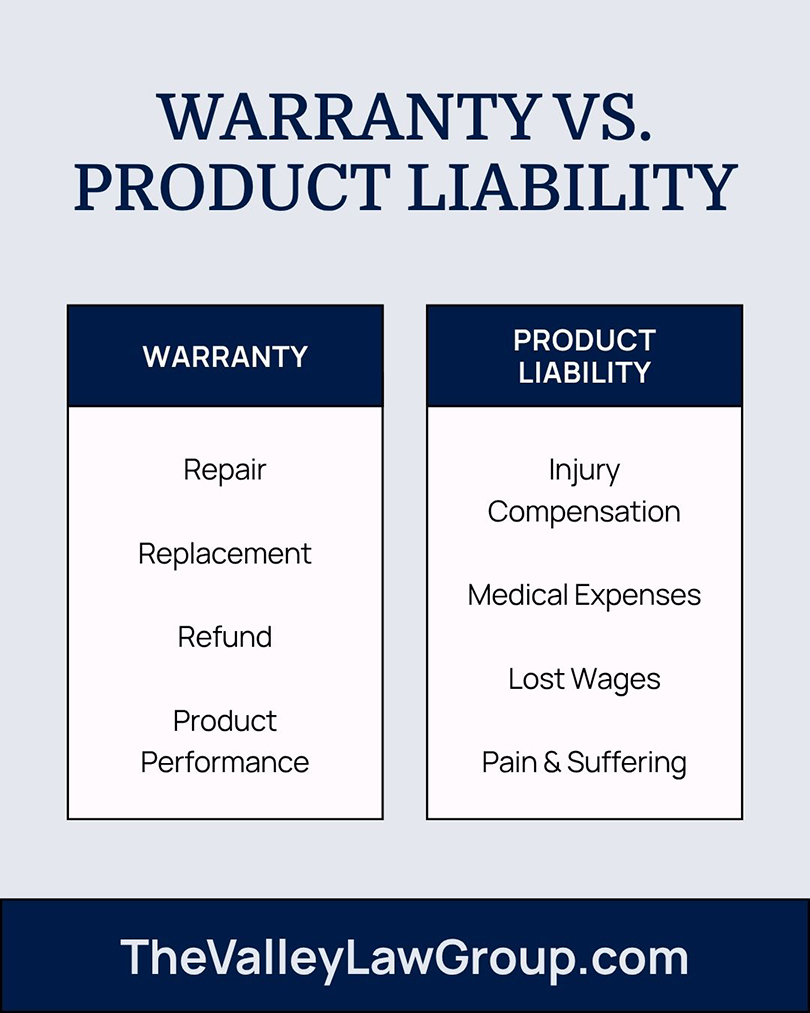
Product liability and warranties are similar concepts but serve different purposes. A warranty is a promise made by a manufacturer or seller regarding the performance and condition of the product. Product liability law addresses situations in which a defective or dangerous product can cause harm.
A consumer may have a warranty issue when a product stops working as intended. If the product causes physical injury, such as burns, lacerations, or poisoning, the matter can extend beyond warranty rights and involve Arizona product liability laws.
Arizona law provides legal remedies to help protect consumers after injuries from defective products.
What Is a Manufacturer’s Warranty?
A manufacturer’s warranty is a written guarantee of a product’s condition, quality, and performance, and it also outlines a promise to remedy any failure of the product. Many product warranties explain how long coverage lasts, which defects are covered, and whether repairs or replacements are available. A warranty also covers whether limitations or exclusions apply and the specific steps consumers should take to make their warranty claim.
Often, a warranty claim focuses on correcting a product issue rather than compensating the buyer for any damages incurred as a result. Damages must be pursued in civil court during a product liability claim.
How Warranties Establish What a Product Was Supposed to Do
Warranty language helps establish the way the product is meant to perform. For example, a warranty can specify how much weight a ladder can safely hold or outline the built-in safety mechanisms for a power tool. In this way, a warranty helps the consumer understand how the product should perform safely.
If the product fails or contradicts those representations, the warranty documents can become relevant evidence in a warranty claim. These defects, or gaps in performance, may be used to establish a product liability claim. In turn, contrasting the product’s expected performance with its actual performance can help the court determine whether these failures specifically led to physical or financial damages.
Common Types of Product Defects
Arizona product liability claims often involve these primary categories:
- Design Defects – A design defect occurs when a product is inherently dangerous by design, such as vehicles prone to rollover or equipment lacking reasonable safety features. If this is the case, all products manufactured this way should demonstrate the same problem.
- Manufacturing Defects – Manufacturing defects occur during production and may affect only a specific batch or group of products.
- Failure to Warn – Manufacturers have a duty to provide adequate warnings and instructions that cover these risks. Failure to do so can lead to product liability concerns. These can include medication side effects or choking hazards.
Can an Expired Warranty Affect a Product Liability Claim?
While an expired warranty will likely prevent you from making a warranty claim to replace or repair the product, it doesn’t automatically prevent you from pursuing a liability claim. The warranty period only determines how long warranty benefits remain available. State legal standards and deadlines govern product liability claim timelines.
The viability of a product liability claim depends on:
- The nature of the defect
- When the injury occurred
- Available evidence
- Applicable statutes of limitation
- The parties involved
Because timing issues can be complicated, it is crucial to consult with an Arizona product liability lawyer promptly after an injury.
Why Preserving Evidence Matters

Consumers often throw away broken products or immediately return them to the manufacturer for a replacement after an issue arises. However, this can create challenges later on, as the product can be a significant piece of evidence in a product liability case.
If a defective product harmed you or a family member, it’s crucial to save as much evidence as possible, including:
- The packaging the product came in
- Instructions and manuals
- Any warning labels
- Receipts.
- Photographs or videos of the product and the malfunction, as well as of any injuries or damage caused
- Any recall notices issued
You’ll also want to make sure your medical care provider has properly documented your injury. Keep track of:
- Emergency treatment records
- Diagnostic imaging results
- Physician reports
- Surgical records
- Therapy documentation
If another person witnessed the injury, request a statement regarding how you were using the product, how it failed, and how the injury occurred.
Preserving evidence is crucial to the success of your case, so avoid throwing the product out or repairing it. Once it’s altered, it may be more difficult to determine whether the defect existed before the accident or was due to user error.
Liability for a Defective Product
Many people assume only the manufacturer can be held responsible when a product malfunctions or otherwise causes harm to the consumer. The truth is, many parties across the supply chain can share responsibility. Liability depends on the facts of the case.
The most common liable parties include:
- Manufacturers – Manufacturers design and produce products. Defects may originate during product design, the engineering phase, the assembly process, or when the product is not thoroughly examined by quality control.
- Component Manufacturers – Individual components are generally supplied by separate companies. If one of the components of the product contributed to the injury, the component manufacturer may be liable for the injury.
- Distributors – Distributors move products through the marketplace to supply them to the consumer. Under some circumstances, their role may be relevant to the investigation.
- Retailer – Retail stores and online sellers are also involved in product distribution. Arizona law and the specific facts of the case play a role in whether the retailer may share responsibility for the injury.
- Other Parties – Additional entities can include importers, wholesalers, assemblers, and installers.
Determining responsibility requires a thorough investigation into the product’s path from production to the consumer.
Attorney Insight from Jonathan Roeder, founding partner of The Valley Law Group, focused on family law, criminal defense, and personal injury.
Many people assume accepting a replacement product or warranty repair ends their legal options. However, when a defective product causes physical injury, your rights may extend far beyond the warranty. Early legal guidance can help preserve evidence, identify every potentially responsible party, and protect your ability to pursue compensation.
When You Should Contact an Arizona Product Liability Attorney
If you have experienced an injury caused by a defective product, early legal guidance can be extremely beneficial. Reaching out to an experienced Arizona product liability attorney can help you preserve necessary evidence and identify possible liable parties.
Your defective product lawyer can also review any warranty issues and evaluate potential claims. Because of filing deadlines, a strong legal advocate can help you avoid missing important deadlines for claiming damages. The sooner the evidence is preserved, the easier it can be to investigate how the incident occurred and where responsibility lies.
Don’t assume that repair, replacement, or a refund adequately settles the issue. You can be compensated for damages after experiencing a defective product with the help of an experienced product liability lawyer.
Why Choose The Valley Law Group?
When a defective product causes harm to the consumer, that consumer may feel unsure of what action to take to collect damages and rectify the situation. Questions may arise about warranties, recalls, evidence preservation, and liability.
The Valley Law Group serves clients in Phoenix, Gilbert, Scottsdale, Peoria, and the surrounding communities. Our firm has built a strong reputation for providing personalized legal representation and helping clients understand their legal rights under Arizona law.
Product liability cases require a thorough investigation. They can involve complicated evidence trails and multiple liable parties across the supply chain. Our team works to evaluate the facts, identify responsible parties, and help our clients gain a clear understanding of how to pursue compensation for injuries and losses resulting from a defective product.
Dealing with product-related injuries can be complicated, but you don’t need to face it alone. The Valley Law Group can provide clarity during a difficult time and advocate for your recovery needs.
Product Liability FAQs
If you’ve been injured because of a defective product, you may have questions about warranties, liabilities, and your legal options.
Some of the frequently asked questions surrounding product liability include:
Contact The Valley Law Group Today
If a defective product caused your injuries, The Valley Law Group can evaluate your case, identify potentially responsible parties, and help you pursue compensation for your losses.
Contact our team today to discuss your situation and learn more about your options under Arizona law.
References
- Arizona Legislature. (n.d.). Arizona Revised Statutes § 12-681: Definitions. https://www.azleg.gov/ars/12/00681.htm
- Arizona State Board of Pharmacy. (n.d.). U.S. Consumer Product Safety Commission. https://sfb.az.gov/resources/us-consumer-product-safety-commission
- National Safety Council. (n.d.). Consumer product injuries. Injury Facts. https://injuryfacts.nsc.org/home-and-community/safety-topics/consumer-product-injuries/
- National Safety Council. (n.d.). Injury Facts. https://injuryfacts.nsc.org/
- Primary News Source. (2025, July 17). Consumer product-related injuries and deaths in the United States: Estimated injuries occurring in 2024 and estimated deaths occurring in 2023. https://primarynewssource.org/sourcedocument/consumer-product-related-injuries-and-deaths-in-the-united-states-estimated-injuries-occurring-in-2024-and-estimated-deaths-occurring-in-2023/
- U.S. Consumer Product Safety Commission. (n.d.). Consumer product safety. https://www.cpsc.gov/

Jonathan Roeder is a founding partner of The Valley Law Group and an Arizona attorney focused on family law, criminal defense, and personal injury. Jonathan has built his practice around helping clients navigate difficult legal issues with clear guidance, practical strategy, and strong advocacy. As an attorney, business owner, and Father of three, he understands the importance of preparation, communication, and helping clients make informed decisions during stressful and uncertain times. Jonathan’s career reflects both professional recognition and a commitment to developing others in the legal field. He has earned numerous legal honors, including recognition as a Super Lawyers Rising Star and a 10.0 “Superb” rating on Avvo, while also mentoring legal students and young attorneys through his work as a college faculty member and leader in his industry.