



Sexual misconduct is a broad term that covers multiple criminal offenses. Because it is an umbrella term, many people facing such charges wonder what sexual misconduct is in Arizona. The term does not, as some may believe, always refer to sexual acts involving physical contact. Often, misconduct consists of unwanted sexual advances or harassment.
Due to the broad scope of alleged offenses classified as sexual misconduct criminal charges in Arizona, many accusations arise from misunderstandings, consent disputes, or false claims. Arizona laws define sex offenses clearly, while also outlining specific acts that are considered sexual misconduct.
Is “Sexual Misconduct” a Specific Crime in Arizona?
Sexual misconduct encompasses a wide variety of inappropriate behaviors and is often used as a catch-all term. This may include harassment, assault, and even consensual acts, such as those that occur between employer and employee. While sexual assault always involves physical contact, sexual misconduct may involve non-physical acts, such as threatening, harassing, or stalking. Non-criminal offenses may also be included.
Sexual misconduct laws in AZ are classified under specific statutes, resulting in numerous charge options rather than a single “sexual misconduct” charge. For example, sexual conduct with a minor is defined under ARS 13-1405 as involving any person who knowingly engages in sexual intercourse or any sexual conduct with a person under 18 years old.
ARS 13-1410 legally defines molestation of a child and is classified as a class 2 felony. However, sexual misconduct occurring between behavioral health professionals and their clients is defined under ARS 13-1418. Another specific statute defines unlawful sexual conduct in correctional facilities, outlined in ARS 13-1419.
Though the term may seem vague, the media, employers, schools, and police still use “sexual misconduct” as it covers a variety of sexually inappropriate behavior that does not fall under criminal acts such as sexual assault or sexual abuse. Instead, it is viewed as an umbrella term for administrative and disciplinary purposes, as well as explaining policies.
Common Acts That May Be Considered Sexual Misconduct in Arizona
As sexual misconduct in Arizona encompasses a wide variety of acts, many may wonder what acts are classified as sexual misconduct.
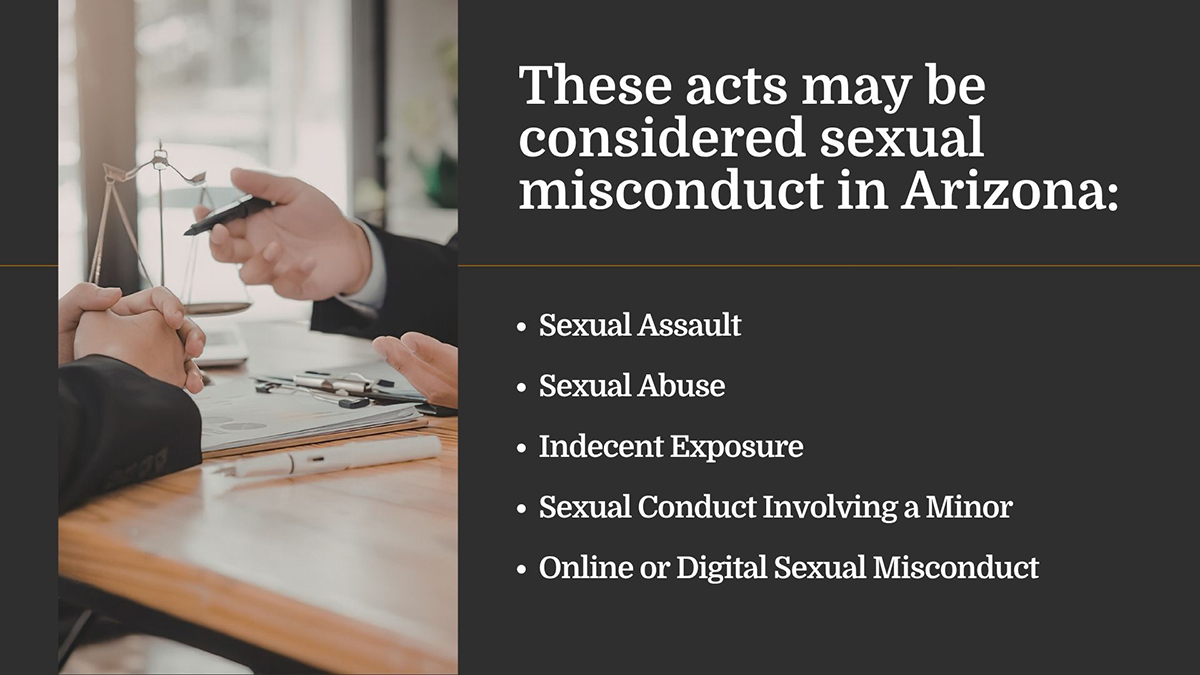
These acts may be considered sexual misconduct:
Sexual Assault
Sexual assault is defined under ARS 13-1406 as an individual knowingly or purposefully engaging in non-consensual sexual intercourse or oral sexual acts. If both individuals do not willingly and freely consent to partake in these sexual acts, then it is considered non-consensual. Disputes may arise as to whether or not consent was expressed, or whether the individual was coerced, especially if they were incapacitated due to alcohol or drugs.
If convicted, sexual assault can result in a class 2 felony, including a penalty of 5.25 years up to 14 years in prison. Understanding what is classified as a sexual offense in Arizona is essential due to the serious consequences involved.
Sexual Abuse
Under ARS 13-1404, sexual abuse is classified as non-consensual sexual contact without intercourse with an individual who is above the age of 15. Conviction of sexual abuse of a person older than 15 results in a class 5 felony. However, if the victim is younger than 15, it is considered a class 3 felony.
If the offense was committed by a person in a position of authority or trust, such as a relative, member of the clergy, teacher, or coach, then using consent as a defense is automatically negated. Additionally, charges are elevated, resulting in more severe consequences.
Indecent Exposure
Indecent exposure involves a person intentionally exposing their genitals or anus, or a woman exposing her areolas, nipples, or breasts to another person (breastfeeding mothers are excluded). It is important to note that the person must be offended or alarmed by the incident (ARS 13-1402). The offender must have a reckless mindset, committing the acts without any concern whether others are alarmed or offended.
Indecent exposure takes place in public spaces and can include mooning and public urination. If neighbors or residents can view the exposure, indecent exposure charges can occur even if the incident takes place on private property.
Some common misunderstandings regarding this offense include what is considered public space. While many individuals believe public exposure refers to exposure occurring in a place like a park or sidewalk, a public space is any place visible to the public, including inside a vehicle, in a backyard, or even through the blinds of a window.
Sexual Conduct Involving a Minor
Sexual conduct involving a minor refers to a person intentionally and knowingly engaging in sexual intercourse or oral sexual contact with a person under the age of 18 (ARS 13-1405). This law operates under a strict liability standard, meaning that the prosecution does not have to provide evidence of the defendant’s understanding that the victim was under 18 years old. Additionally, a minor concealing their true age in order to partake in the sexual acts cannot be used as a defense.
In Arizona, the age of consent is 18 years old. This means that those under 18 cannot legally consent to engage in sexual acts. To do so could result in statutory rape charges or sexual conduct with a minor charges in accordance with ARS 13-1405.
Conviction of this criminal sexual misconduct in Arizona can result in severe penalties, such as a prison sentence of several years to life depending on the severity of the crime. Other penalties can include hefty fines, probation, and mandatory mental health treatment. Offenders must register as a sex offender, impacting the ability to pursue certain employment, housing, or travel opportunities. After registering, they will be assigned a sex offender level.
Online or Digital Sexual Misconduct
Sexual misconduct offenses may also take place online or via digital devices. As outlined in ARS 8-309, it is illegal for minors to intentionally use or possess electronic communication to send pictures or videos of sexual material. This includes sending sexual material of themselves or of other minors. If adults engage in sexting with minors, they could be charged with a class 2 felony or Dangerous Crimes Against Children (DCAC), especially if materials possessed or distributed are considered child pornography.
Consensual “sexting” between adults is not considered illegal. However, if a person distributes, publishes, or advertises private images of a sexual nature without the other party’s consent, they could be charged with a class 4 or 5 felony (ARS 13-1425).
Social media posts and messages may be useful evidence in these cases, demonstrating harassment, sexual exploitation of minors, or the unlawful distribution of images.
How Arizona Law Defines Consent
As laws concerning consent can be complicated, charges are frequently disputed. If one or both parties were incapacitated due to alcohol or drugs, for example, some argue that there are gray areas concerning when a person is too intoxicated to consent.Due to the serious consequences that can result from disregarding consent, it is essential to understand consent and Arizona law
Consent refers to expressed words or overt actions that signify that an individual willingly and freely agrees to certain sexual acts.

Under ARS 13-1401, consent cannot be given if:
- The victim is coerced or threatened to impel them to engage in sexual acts
- The victim is incapacitated due to a mental disorder or defect, is under the influence of drugs or alcohol, or was sleeping at the time of the incident
- The victim is deceived to impel them to engage in sexual acts
- The victim is deceived into believing that the person is their spouse
To assess consent, the court may consider whether individuals involved were ever in a romantic or sexual relationship, the duration of that relationship, how often the two interacted, and how much time has passed after it ended.
It is crucial to note that consent that is freely given may be withdrawn at any time. If a person begins engaging in a sexual act with another person after giving consent, but withdraws consent suddenly, the act must be immediately stopped. Any individual refusing to stop may be charged with sexual assault.
Sexual Misconduct vs. Sexual Assault vs. Sexual Abuse
It can be easy to confuse a sexual offense vs. misconduct in Arizona. Sexual offenses, however, are clearly outlined under criminal law. These offenses include sexual assault, child molestation, or sexual abuse, which result in severe penalties and require registration as a sex offender.
Sexual misconduct covers various sexual acts that are often found in employee or university handbooks and detailed above.
Sexual assault is legally defined as someone purposefully engaging in sexual intercourse or oral sexual acts without the consent of the other person (ARS 13-1406). Sexual abuse involves knowingly engaging with a person under the age of 15 or younger without their consent (ARS 13-1404).
The three can be quickly summarized as follows:
- Sexual Misconduct – A broad definition of inappropriate sexual behaviors
- Sexual Assault – Includes penetration without consent
- Sexual Abuse – Includes sexual contact without consent
When Sexual Misconduct Overlaps with Assault or Domestic Violence
Sexual misconduct, including sexual assault and rape, is possible between married couples or romantic partners. Because these sexual offenses are violent in nature, they are often considered domestic violence. In other cases, one partner may accuse another without merit, often in high-conflict divorce or child custody cases. Falsely accusing a spouse or partner of domestic violence has serious repercussions, as conviction can result in a prison sentence and registration as a sex offender.
Domestic violence is not a standalone crime but rather a tag added to other criminal actions as specified in ARS § 13-3601. Sexual assault against a former or current spouse, a person with whom the offender shares a child, or a former partner is labeled domestic violence. The close relationship of the parties involved elevates the severity of the sex crime allegations in Arizona.
These criminal domestic violence charges can impact family court proceedings, including necessary adjustments made to parenting agreements, other custody matters, or divorce cases. A domestic violence conviction may also require an order of protection for the spouse/partner and children.
Potential Penalties for Sexual Misconduct-Related Charges
Consequences for sexual misconduct charges may be severe, impacting your future and your reputation.
Depending on the severity or the type of the offense, sexual misconduct charges could result in a felony or a misdemeanor. Other penalties include serving a prison sentence of several years up to a life sentence for serious offenses. Fines, probation, and mandatory sex offender registration are also likely. Registration as a sex offender not only affects your reputation but also limits employment and housing options.

What to Do If You’re Accused of Sexual Misconduct
Being accused of sexual misconduct is overwhelming, but it is important to remain calm and take appropriate action:
- Do not explain your side to the police alone.
- Secure representation from a criminal defense lawyer as soon as possible.
- Do not contact the accuser by phone, text message, email, or in person.
- Keep all texts, messages, and timelines that may serve as evidence.
Speaking with an attorney can help you understand your rights while defending you against sex crime allegations with a personalized defense strategy.
Accused of Sexual Misconduct in Arizona? Get Answers Before Charges Escalate [H2]
Sexual misconduct accusations require immediate attention from experienced attorneys who will confidentially handle your case. Early intervention can make an enormous difference in the outcome of your case. Seeking legal counsel from The Valley Law Group’s team of criminal defense attorneys is your best chance of preserving your freedom.

We offer 24/7 availability for those who have arraignments or urgent arrests. Contact us today to schedule your free consultation, discuss your case, and learn your legal options.
Sources:
- Arizona Revised Statutes § 13-1406. (n.d.). Sexual assault; classification; increased punishment. Retrieved April 6, 2026, from https://www.azleg.gov/ars/13/01406.htm
- Arizona Revised Statutes § 13-1404. (n.d.). Sexual abuse; classification. Retrieved April 6, 2026, from https://www.azleg.gov/ars/13/01404.htm
- Arizona Revised Statutes § 13-1402. (n.d.). Indecent exposure; classification. Retrieved April 6, 2026, from https://www.azleg.gov/ars/13/01402.htm
- Arizona Revised Statutes § 13-1405. (n.d.). Sexual conduct with a minor; classification. Retrieved April 6, 2026, from https://www.azleg.gov/ars/13/01405.htm
- Arizona Revised Statutes § 8-309. (n.d.). Child welfare and protection provisions. Retrieved April 6, 2026, from
- Arizona Revised Statutes § 13-1425. (n.d.). Sexual exploitation of a minor; classification. Retrieved April 6, 2026, from https://www.azleg.gov/ars/13/01425.htm
- Arizona Revised Statutes § 13-1401. (n.d.). Definitions (sexual offenses). Retrieved April 6, 2026, from https://www.azleg.gov/ars/13/01401.htm
- Arizona Revised Statutes § 13-1418. (n.d.). Sexual assault kit tracking; victim rights. Retrieved April 6, 2026, from https://www.azleg.gov/ars/13/01418.htm
- Arizona Revised Statutes § 13-1410. (n.d.). Molestation of a child; classification. Retrieved April 6, 2026, from https://www.azleg.gov/ars/13/01410.htm
- Arizona Revised Statutes § 13-1419. (n.d.). Unlawful disclosure of images depicting states of nudity or sexual activity. Retrieved April 6, 2026, from https://www.azleg.gov/ars/13/01419.htm

Jon McCarty has broad experience in a wide variety of criminal defense and family law matters. After graduating from the University of Illinois College of Law with the highest honors, Jon served as Law Clerk to The Honorable David Briones in the United States District Court for the Western District of Texas. After running a successful practice of his own for many years, Jon relocated to Maricopa County where he has continued to strive for excellence through aggressive yet compassionate representation of each client. Jon has been named to the list of Super Lawyers in the area of family law multiple times, and has been recognized for his outstanding commitment to Equal Access to Justice through providing pro bono representation to numerous clients.