


Unlawful discharge of a firearm in Arizona charges can often be a surprise for gun owners. You may believe that you were operating legally, only to find yourself suddenly facing a felony weapons charge. Firing a weapon in city limits, even without intent to harm anyone or without aiming at another person, can still result in serious criminal consequences.
The penalties associated with an unlawful firearm charge can be severe, with potential for years in prison, hefty fines, and ongoing restrictions on your firearm rights. Early legal action can be essential in mitigating its impact on your life, whether through a dismissal or a reduction in sentencing and conviction guidelines.
If you are facing these types of charges, it’s important to know the key actions you should take. The Valley Law Group is here to help you understand what constitutes an unlawful discharge of a firearm in Arizona, potential penalties, and actions you can take to bolster your defense case.
What is an Unlawful Discharge of a Firearm Charge in AZ?
An unlawful discharge of a firearm in Arizona is a common type of firearm offense. According to Arizona Crime Statistics data, weapons law violations made up 6.9% of crimes against society arrests, resulting in more than 1,800 arrests (AZ DPS, 2024).
Legitimate unlawful discharge of a firearm charges in AZ do not require the intent to injure to move forward in court. These charges encompass many instances of firing a gun within city limits.
However, there are a few circumstances excluded from criminal consideration, which include:
- A gun was fired on a supervised range.
- Blanks were used as ammo.
- The gun was shot more than one mile from any occupied structure.
- The discharge occurs with permission from the chief law enforcement officer in the municipality.
- A firearm was used to control nuisance wildlife, as defined by state and federal agencies.
- The firearm was discharged in lawful self-defense or defense of another during an animal attack.
Unlawful discharge of a firearm charges are typically prosecuted using a statute known as Shannon’s Law in Arizona, named after legislation passed after a fourteen-year-old girl, Shannon Smith, was killed by a stray bullet in Phoenix in 1999. This legislation increased the penalty for criminal negligence firing of a weapon from a misdemeanor to a class 6 felony.
Common Scenarios That Lead to an Unlawful Discharge of a Firearm Charge in Arizona
In Arizona, most unlawful discharge of a firearm charges originate from innocuous moments that do not seem significant enough to warrant a criminal conviction.
Learn about these common scenarios so you can avoid an unlawful discharge case:
- Celebratory Gunfire – Many Arizonans fire their weapons in celebration on a holiday or other momentous occasions. Firing into the air in these moments, with no intent to harm anyone, is still dangerous and one of the most common reasons for an unlawful discharge offense.
- Firing Within City Limits – Firing a gun within city limits in AZ may result in a charge. Even if the area seems sparsely populated, abandoned, or remote, if it is within the municipality, you may be subject to unlawful discharge statutes.
- Reckless Handling of a Firearm – Mishandling a loaded weapon, pointing in an unsafe direction, and failing to clear a firearm when cleaning can all result in an unlawful discharge case.
- Accidental Firings – Accidental discharges are frequently named as grounds for unlawful discharge charges. These incidents may occur when cleaning, holstering, or storing a weapon and are considered criminal negligence.
- Misunderstandings of Rural vs Urban Areas – A common point of confusion that results in criminal charges is the distinction between a rural and an urban zone. While you may think you have traveled far enough away from the population center, you may still be within city limits.
Is Unlawful Discharge a Felony or a Misdemeanor in Arizona?
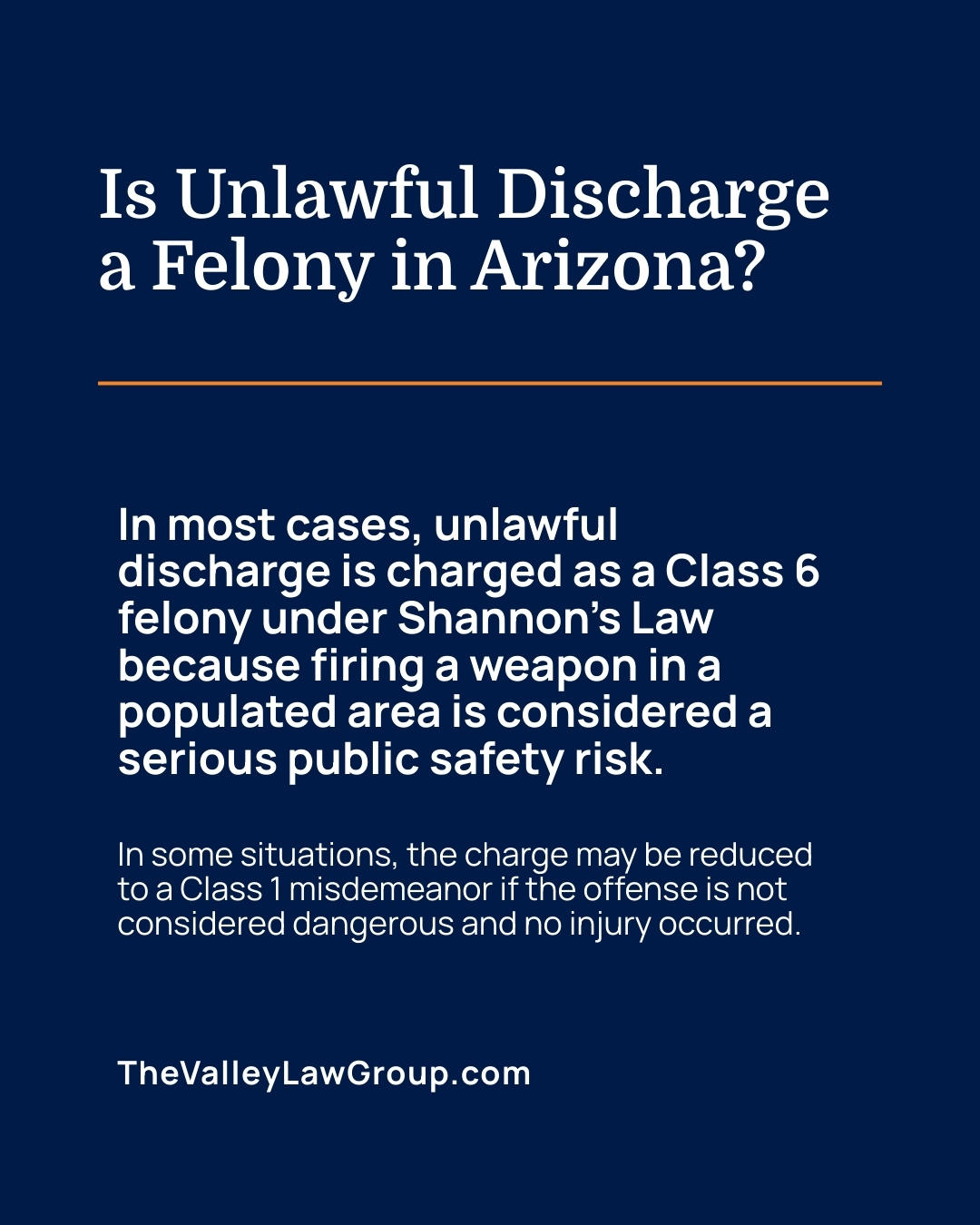
Cases are typically prosecuted aggressively and remain felonies due to the public safety risks of firing a weapon in a populated area.
One key distinction in determining if a case is a felony is whether it is classified as a dangerous offense. Under Arizona state law, certain crimes are treated as dangerous when they involve weapons-related conduct, including firing or brandishing a weapon. The law also applies when the accused intentionally causes significant physical injury to another person.
When considering if an offense is dangerous, the fact that a weapon was discharged is not the main concern. Instead, courts focus on the threat of harm or any physical injury that occurred first, followed by the intent.
Cases that are not considered dangerous may be prosecuted as a class 1 misdemeanor, significantly reducing the impact on penalties and firearm rights.
Potential Penalties and Consequences for an Unlawful Firearm Discharge Convictions
A felony firearm discharge in Arizona is often prosecuted harshly, with severe penalties and consequences for your life. Penalties depend on whether you are charged with a misdemeanor or a felony, as well as whether you have been charged with a dangerous felony before.
Jail or Prison Time
Incarceration is the central penalty used for all criminal offenses. The length of a prison or jail sentence depends on whether the charge is a felony or a misdemeanor, whether it is considered dangerous, and whether there were any prior convictions.
If you’ve been charged with unlawful discharge of a firearm as a first-time offender, you can expect these penalties:
- Non-Dangerous Unlawful Discharge – A judge may order anywhere from four months to two years in jail or prison.
- Dangerous Unlawful Discharge – The mandatory minimum sentence is one and a half years imprisonment, but you can receive up to three years.
If you are a second-time unlawful discharge or dangerous felony offender, you can expect:
- Non-Dangerous Unlawful Discharge – You’ll receive anywhere from nine months to two years and nine months in prison.
- Dangerous Unlawful Discharge – The mandatory minimum sentence is three years imprisonment, but you may receive up to four and a half years.
A third felony or dangerous offense will mean:
- Non-Dangerous Unlawful Discharge – You should expect anywhere from one to 3 years and nine months in prison.
- Dangerous Unlawful Discharge – A judge must sentence you to a minimum of four and a half to six years in prison.
Fines
Fines are another key tool prosecutors use in sentencing. The final sum owed varies widely depending on whether the conviction is for a felony or a misdemeanor. According to the Arizona legislature, fines for a misdemeanor can be up to $2,500. Under state law, fines for a felony can reach as high as $150,000. Restitution payments may be ordered if parties were harmed in an incident.
Other Potential Penalties
After you complete the terms of your sentence and pay your fines, the consequences of an unlawful firearm discharge conviction can affect your future in many ways, such as a felony appearing on your permanent criminal record going forward. Another ongoing factor is a loss of your firearm rights.
What to Do Immediately After Being Charged
The actions you take after an unlawful firearm discharge charge can have a large impact on your case’s outcome and your defense.
Refrain from Making Public Comments
The first thing to do when charged with an unlawful firearm discharge offense is to refrain from any public comments. Many have the understandable urge to defend themselves publicly or explain on social media what they are going through. This should be avoided entirely. Anything you say during an investigation or court proceeding can be used by the prosecution to harm your defense.
Take the Process Seriously
A common mistake Arizonans make during an unlawful discharge case is assuming that the charge is a minor offense. Both non-dangerous and dangerous convictions can result in years in prison, hefty fines, and a permanent felonious criminal record. Taking the process seriously is crucial to your defense and includes promptly responding to court requests, attending all hearings, and meeting each deadline in the proceedings.
Abide by the Conditions of Your Release
After your release from jail, you should follow the terms and conditions ordered by the courts. Common bond conditions include a prohibition on possessing firearms, restrictions on leaving the county or state without permission, a prohibition on contacting witnesses and other parties involved in the case, electronic monitoring, and regular reporting to pretrial services. Violating these terms can lead to additional criminal charges and harsher punishments.
Secure Professional Legal Defense
The final step you should take in your case is to contact a criminal defense attorney as soon as possible. Legal aid can be essential for minimizing penalties or obtaining a dismissal. The earlier an attorney is involved, the larger impact they can have on the proceedings.
How Unlawful Discharge Cases Are Investigated in Arizona
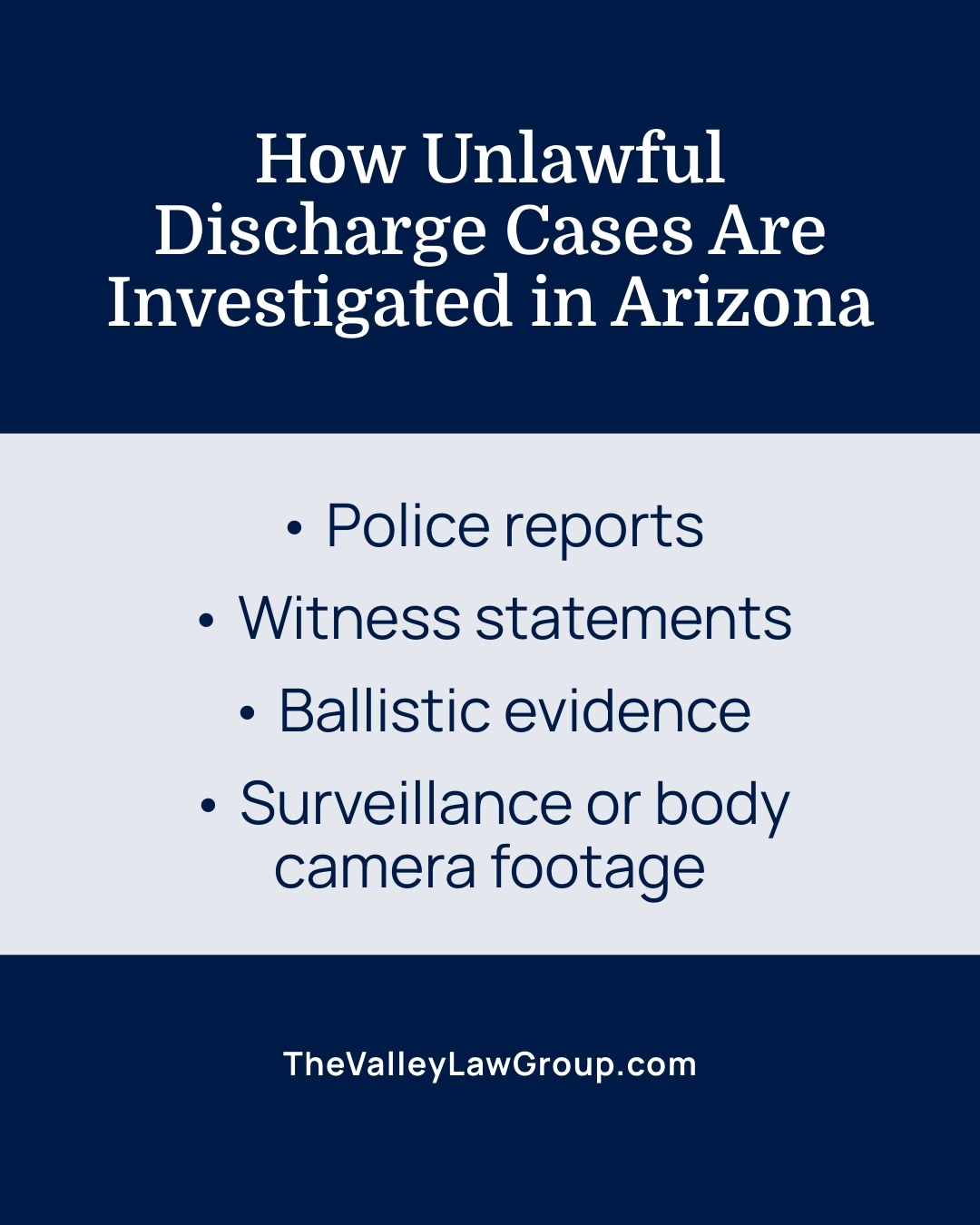
It is important for those charged with an unlawful discharge of a firearm offense to understand the approach law enforcement uses in Arizona to investigate claims. Officers review the timeline of events, who shot the gun, where the gun was fired, the direction it was aimed, and the apparent mental state of the shooter in the moment.
Evidence commonly includes:
- Police Reports – These reports are often the foundation of the prosecution’s case.
- Witness Statements – Witness testimony can be strong evidence in a case. However, perceptions can be influenced by stress, limited visibility, or personal bias if the witness knew the defendant.
- Ballistic Evidence – Ballistic evidence can involve shell casings, bullet fragments, and impact points. The location of shell casings and damage to nearby structures can be used to support or refute allegations.
- Surveillance Video or Audio Recordings –This can include body camera footage or video from nearby security cameras.
Investigators rely heavily on physical and digital evidence. This may be challenged if inconsistencies or procedural errors are identified.
Common Defense Strategies Used in Arizona for Unlawful Discharge Cases
The strongest defense against an unlawful discharge charge in Arizona varies on a case-by-case basis and depends on the circumstances of each case. An attorney who has handled similar cases can help you decide the approach to use.
A few common strategies utilized include:
- Lack of Recklessness – One key defense in many cases is challenging the basis that a firearm was fired recklessly. Demonstrating that a shooter took safety precautions, had no intent to endanger any person, and that unsafe conduct was minimal can all be effective in reducing or dismissing charges.
- Disputing the Location – The area in which a firearm was shot is a central element in establishing if a charge falls under Shannon’s Law in Arizona. Some incidents occur on municipal boundary lines, and it can be disputed whether they occurred within city limits.
- Accidental Discharge – A firearm may have been fired by accident, with no intent to harm. While penalties may still apply, they will be less severe.
- Lack of Evidence – Prosecutors in Arizona must have sufficient evidence to prove a firearm was fired recklessly and against the law. Circumstantial, weak, or no evidence can be grounds to have charges dismissed.
- Police Procedural Errors – Investigations must be conducted in line with standard rules and regulations.
- Mistaken Identity – Some cases involve false allegations and a case of mistaken identity. You may have been near someone who fired a weapon, or a firearm was discharged on your property.
How a Weapons Charge Defense Lawyer Can Help Your Case
Unlawful discharge cases can be confusing and overwhelming to handle on your own when facing imprisonment and a lasting impact on your life. A weapons charge defense lawyer can have many key benefits for your case and improve your results.
A few key ways a skilled defense attorney can help you improve your case include:
- Local Knowledge – Every jurisdiction handles an unlawful discharge case differently, with changes between law enforcement agencies, city laws, prosecution approaches, and courtroom procedures. Hiring a lawyer experienced in your local legal community can guide you in shaping your case to match your specific scenario.
- Building Your Defense – Each case requires a different strategic approach. Your legal counsel can examine your situation and determine the strongest defense for you.
- Challenging Evidence – Evidence plays a central role in unlawful discharge cases, but must be credible and untainted by procedural errors. An attorney can review the evidence against you and challenge mistakes made by technicians and law enforcement.
- Representation in Court – Court appearances can be stressful and overwhelming events, particularly when facing a felony charge and years in prison. A lawyer can represent you in all hearings and meetings related to your case, both inside and outside the courtroom.
- Negotiating with the Prosecution – Unlawful discharge cases are often pursued aggressively by the prosecution, and securing a reduced penalty or a conviction requires skilled negotiation and numerous discussions between the parties. Your attorney can play a critical role in advocating for you and presenting a strong case for leniency.
- Protecting Your Firearm Rights – A federal conviction, including unlawful firearm discharge offenses, often results in a lifetime ban on possession of firearms. However, this can be avoided through a thorough legal defense. Your attorney can fight for a certificate of second chance that can allow you to retain your firearm possession rights.
An unlawful discharge of a firearm charge is a serious offense that can result in prison time, permanent loss of firearm rights, and lasting consequences on your future. Timely, informed legal action can be essential in avoiding imprisonment, reducing the impact on your life, and protecting your future firearm rights.
Contact The Valley Law Group Today
If you are facing charges of unlawful discharge of a firearm in Arizona, The Valley Law Group can help with your case. Our team of experienced criminal defense attorneys has combined decades of legal experience with local courts, including Peoria Municipal Court and Maricopa County Court. We’ve also handled cases in Phoenix, Scottsdale, and across the Valley.
Our team works to highlight flaws in the prosecution, represent you in all court proceedings, and negotiate a plea bargain that defends you against the maximum penalties.
Contact us today to book your initial consultation with The Valley Law Group. In this meeting, we will listen to your story, review the charges against you, and discuss potential legal pathways forward in your case.
Then, we can immediately begin building a strong defense that protects your freedoms and gives you the strongest chance of a favorable outcome.

Resources:
- Arizona Department of Public Safety. (2023). Arizona crime statistics: Crime overview report. Retrieved October 10, 2025, from https://azcrimestatistics.azdps.gov/tops/report/crime-overview/arizona/2023
- Arizona Revised Statutes § 13-105. (n.d.). Definitions. Retrieved October 10, 2025, from https://www.azleg.gov/ars/13/00105.htm
- Arizona Revised Statutes § 13-802. (n.d.). Fines for misdemeanors. Retrieved October 10, 2025, from https://www.azleg.gov/ars/13/00802.htm
- Arizona Revised Statutes § 13-801. (n.d.). Fines for felonies. Retrieved October 10, 2025, from https://www.azleg.gov/ars/13/00801.htm
- Arizona State Legislature. (2020). House Bill 2402 (54th Legislature, Second Regular Session). Retrieved October 10, 2025, from https://www.azleg.gov/legtext/54leg/2r/bills/hb2402p.htm

Jon McCarty has broad experience in a wide variety of criminal defense and family law matters. After graduating from the University of Illinois College of Law with the highest honors, Jon served as Law Clerk to The Honorable David Briones in the United States District Court for the Western District of Texas. After running a successful practice of his own for many years, Jon relocated to Maricopa County where he has continued to strive for excellence through aggressive yet compassionate representation of each client. Jon has been named to the list of Super Lawyers in the area of family law multiple times, and has been recognized for his outstanding commitment to Equal Access to Justice through providing pro bono representation to numerous clients.