

Understanding Arizona’s child custody laws
You don’t have to do this alone.
When parents divorce, it’s important to create a childcare plan in the children’s best interests. Should the parents disagree on child custody matters, the court will issue a plan that considers the child’s health and welfare. These decisions can include how often the child spends time with each parent, as well as which parent will be considered the primary caregiver and which parent will be responsible for making important legal decisions. Other people, such as relatives or unmarried parents, may request custody or parenting time as well.
Planning for child custody in Arizona can be stressful, but you don’t have to do this alone.
Our team at The Valley Law Group has prepared a free guide addressing several questions we often hear from concerned parents in Arizona. If you’re involved in a child custody case, it is crucial to understand the laws and statutes that apply to your case.
Child custody hearings can be stressful for everyone, and our goal is to provide a clearer understanding of this situation to mitigate the stress and ensure your child’s needs are met.
Child Custody in Arizona Defined
Arizona’s child custody laws are different from other states, primarily due to the legal terminology used. According to Arizona law, legal custody is referred to as “decision-making” rights, whereas physical custody is termed “parenting time.” If a parent has physical custody, they are required to provide housing, food, and any other necessities. Legal custody, on the other hand, involves decisions about the child’s schooling, healthcare, and more.
Who Determines Legal and Physical Custody?
In some cases, the parents agree on physical and legal custody (parenting time and legal decision-making) arrangements. If this occurs, a judge must simply evaluate the agreement and either approve or make changes.
However, in situations where parents cannot come to an agreement, the Family Court will determine legal and physical custody of the children.
The court may seek testimony from third-party experts who understand the family dynamic and can provide an opinion about custody. In certain cases, social services may be called in to evaluate the custody matter.
What Are "Best Interests"?
- The child’s relationship with their parents (past, present, and future)
- The child’s relationship with siblings and other family members
- The child’s status in school, the local community, and home
- Mental and physical health of both the child and their parents
- Any history of domestic and child abuse
- The child’s wishes, if the child is mature enough to communicate a reasonable preference

For example, if there is a history of a parent dealing with substance use disorder, the court may adjust how much time the child spends with that parent.
The court may also prioritize arrangements where the child does not need to change schools or neighborhoods, or move away from family and friends.
It is important to note that Arizona does not specify how old a child must be to express the desire to live with one parent over the other. In some, but not all, cases, the court will consider the child’s desire to live with one parent.
Download a Free Arizona Child Custody Guide
By studying the Arizona family law materials, you will learn to prepare for court proceedings that may substantially affect how your child(ren) will be raised and the time you will spend with them.
Gaining knowledge in this area puts you in the best position to achieve your goals so you can continue to offer your child(ren) a promising future and provide a happy family life.
We hope it will help you make informed decisions at this very important time in your life.
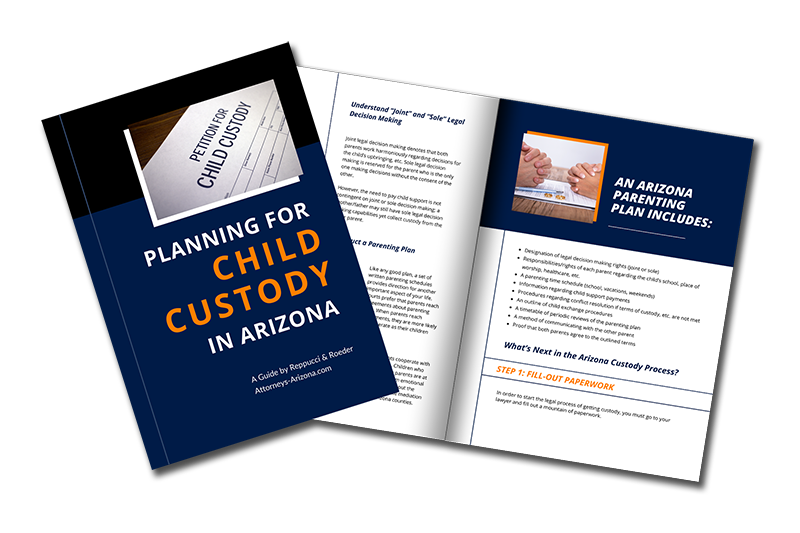
Check out our professional guidance to help you through these difficult times.
Sole and Joint Custody in Arizona
In certain cases, a parent can receive full legal and physical custody of their child, known as sole custody.
If a parent is awarded sole custody of their child, they will be responsible for making all the major decisions that influence the child’s welfare and health, and the child will live with that parent.
While both parents may discuss the child’s care, the parent with sole custody makes the final decision, regardless of whether the parents agree or not.
Alternatively, parents may be issued joint custody of their child, both in terms of parenting time and decision-making rights.
The parents must submit a written parenting plan and receive court approval for any agreement. It’s important to note that parents may agree to joint legal custody of their children but not joint physical custody.
Suggested Reading: Joint vs Sole Custody in AZ

AZ Child Custody Law FAQs
No child custody case is the same, and all parents and children have unique needs and wishes. It’s common for parents planning for child custody in Arizona to have more specific questions about their situation.
Here are some frequently asked questions regarding Arizona child custody cases.
Yes, fathers can get child custody, both in a sole or joint custody situation. Decades ago, this was more difficult for fathers to achieve, but times have changed. It’s important to keep in mind that the court considers the child’s best interests in all custody decisions. Gender is not considered when determining the child’s best interests, and fathers are often successful caregivers.
Arizona courts do not favor sole or joint custody but do attempt to allow the child to maintain healthy relationships with both parents. The court will determine the child’s best interests and award custody based on the situation that best meets the child’s needs. If possible, work with your child’s other parent to determine a parenting time plan that is mutually agreeable to both sides, then submit your custody plans to the court for approval.
The timeline varies depending on the type of adoption, but most cases take several months to a year.
It depends on the strength of the evidence and the specific circumstances of your case. Sometimes a plea deal can significantly reduce penalties, but in other cases, fighting the charges may offer a better outcome. An experienced criminal defense attorney can help you evaluate all options before making a decision.
Yes, you have the right to hire a mediator to assist with your child custody case. Mediation allows for a more stress-free and less emotionally-charged discussion surrounding parenting time and decision-making rights. If you’re anticipating contention during your proceedings, consider hiring a mediator to help you arrive at a mutually beneficial parenting agreement.
If both parents reside in Arizona, the parent with physical custody must notify the other parent 60 days prior to moving the child more than 100 miles or out of the state. With a 60-day notice, the other parent is given plenty of time to request a hearing and prevent the child from moving.
If your job requests an immediate relocation before the 60 days is complete, the parent must have joint physical custody, as well as the agreement of both parents or a court order. If an agreement is not reached before the 60-day period concludes, the working parent must file a request with the court.
Yes, any person who is acting in loco parentis, or in place of a parent, to a child may request custody or parenting time. To be considered in loco parentis, you must have been treated as a parent by the child and formed a meaningful parent relationship.
Before making a request, there are other requirements that must be met:
- One of the child’s parents is deceased or has been missing for 90 days.
- The child was born to unmarried parents.
- A court case for legal separation or divorce between the legal parents is pending.
Until legal paternity is established, Arizona law states that the child should remain with the mother. Once legal paternity is determined, the court will determine a parenting arrangement. The court will use the child’s best interests to inform its decision.
Suggested Reading: Mothers and Child Custody in AZ
According to the law, the child cannot choose which parent gets custody. While the child’s wishes may be considered in Arizona custody cases, the child must be able to communicate a valid preference. In addition, children are often not brought into court to communicate these wishes. When determining the child’s best interests, a mental health professional or guardian ad litem may do the communicating with the court.
Yes. Both parents are permitted access to their child’s records unless the release of the records would place the child or parents in danger. No matter which form of custody is in place, both parents are allowed the same level of access to their child’s records.
Any parent determining child custody, visitation, or child support in an Arizona court must take Arizona’s Parenting Information Course. In addition, if you petition the court for a modification of either custody or child support, the court may request that you or the child’s other parent take the course.
FAQs Regarding Parenting Time
After the parents have divorced, it is crucial for the child to have a strong relationship with both. The child must have an opportunity to spend time with each parent, and many parents in Arizona have asked about parenting time.
Below are frequently asked questions regarding parenting time in Arizona.
Each parent is allowed a reasonable amount of parenting time so the child can keep in contact with both parents. Parenting time can be reduced or denied if the child’s physical, emotional, or mental health is in danger due to time spent with one parent. Parenting time may also be reduced if it would be in the child’s best interests to remain with the other parent during the school year or to stay close to a neighborhood, church, or other family.
There is no set requirement for how long each parent should spend with their child, but there may be cases where visiting for shorter periods frequently may be better. If you’re unsure how much parenting time is best, consider looking at the Model Parenting Time Plans that the Arizona Supreme Court has established. If you still cannot agree on parenting time arrangements, the court will determine this for you.
Suggested Reading: Guide to Parenting Time in AZ
Arizona courts do not favor sole or joint custody but do attempt to allow the child to maintain healthy relationships with both parents. The court will determine the child’s best interests and award custody based on the situation that best meets the child’s needs. If possible, work with your child’s other parent to determine a parenting time plan that is mutually agreeable to both sides, then submit your custody plans to the court for approval.
The timeline varies depending on the type of adoption, but most cases take several months to a year.
It depends on the strength of the evidence and the specific circumstances of your case. Sometimes a plea deal can significantly reduce penalties, but in other cases, fighting the charges may offer a better outcome. An experienced criminal defense attorney can help you evaluate all options before making a decision.
The Valley Law Group Can Help
Determining child custody – whether parenting time or legal decision-making rights – can be challenging, especially when the parents are no longer amicable.
It is crucial for any custody arrangements to meet the child’s best interests, and this is the court’s utmost priority.
To determine the child’s best needs and reach an agreement that is amenable for parents and children, it is essential to contact an Arizona child custody attorney.

At The Valley Law Group, our Arizona child custody lawyers have amassed decades of experience helping parents determine child custody matters.
Planning for child custody in Arizona can be difficult, but an attorney can help you determine what’s best for your child and create a parenting plan that meets those needs. Don’t navigate this complex scenario alone – seek help from our qualified attorneys.
Child Custody Articles from Our Blog
Our blog covers a wide range of child custody related topics, including legal advice, co-parenting strategies, emotional support for parents and children, and the latest developments in custody laws.
Whether you’re going through a custody dispute, looking for tips on creating a parenting plan, or seeking ways to support your child’s well-being during this challenging time, our expert-written articles offer practical guidance and compassionate advice to help you every step of the way.

Child Support Arrears & Interest in Arizona
Learn how child support arrears and interest work in Arizona, including calculations, payment plans, purge payments, and common enforcement pitfalls.

School and Medical Decisions in Joint Custody
Learn how Arizona family courts handle school and medical decision disputes when parents share joint legal decision-making.

Custody Evaluations and Psychological Testing in Arizona
Learn what custody evaluations and psychological testing mean in Arizona custody cases, what is considered, and how to prepare for the process.