



Foreign travel can be a wonderful, life-changing experience; if you have family or business ties abroad, it’s nothing short of essential. Before you plan any travel overseas, however, it’s important to gather the proper travel documents, namely, your passport, which is required for all United States citizens traveling abroad. Your passport serves not only as proof of your identity but also as verification of your US citizenship, allowing you to enter and exit the US and foreign countries. It also serves as your access pass to essential protections and services abroad, including support from the US consulate.
To obtain a passport, you must be approved via the official passport application process. If you’re new to the process – or if you’ve accumulated a criminal record since your last passport expired – it’s essential to know that the federal government can deny your application for many reasons, including certain criminal offenses. In fact, the US government maintains that having a passport is not a right but rather a privilege. While it is possible to get a passport as a felon, you may face restrictions, which can vary depending on the type of felony, the status of your sentencing, and any existing court orders.
If you’re planning to travel overseas, it’s important to understand the laws that apply to your situation. Even with a past felony conviction, you may still be able to travel abroad. Learn more about passport requirements for individuals with a criminal record from the defense team at The Valley Law Group.
Can A Felon Get a Passport?
If you have a criminal history, determining whether you are still able to obtain a passport is a crucial first step to take before planning overseas travel. If you’ve been convicted of a felony, the idea of traveling internationally might feel out of reach, but in many cases, a passport is still possible. If you’re eligible as a felon, you’ll need to follow the same steps as any other US citizen.
Learn more about the general steps and requirements for obtaining a US passport so you can plan ahead:
Step 1: Complete the Passport Application Form
In general, you must begin by visiting your local passport office to pick up a DS-11 form. Alternatively, fill out and print the US Department of State’s online form.
Step 2: Obtain a Passport Photo
There are strict requirements for a valid passport photo, and photos are not available at the passport office. Most people choose to visit their local post office or commercial pharmacy chain to ensure a valid photo.
Step 3: Gather Identification Documents
You’ll need original and photocopied proof of citizenship, like a valid passport, birth certificate with a raised seal, or a Certificate of Citizenship. You’ll also need original and photocopied identification, like a valid driver’s license, state-issued non-driver ID, or military ID.
Step 4: Submit Your Documents
If you’ve never had a passport before, you must submit your documents in person at a US passport acceptance center or regional office (most often at a library or post office), so check to see if your passport location requires appointments in advance. Some eligible individuals may apply for a renewal passport online.
Step 5: Pay Fees
At the end of your appointment or online session, you must pay fees by card, check, or money order. Fees will depend on whether you are applying for a new passport, a renewal, an expedited passport, etc.
Step 6: Wait
Unless you are applying for an expedited passport at a US passport acceptance center, you should plan to wait at least six to nine weeks for your passport. Issues processing your passport can cause the process to take longer, so it’s recommended that you apply for your passport several months in advance of travel.
When Can a Felon Be Denied a Passport?
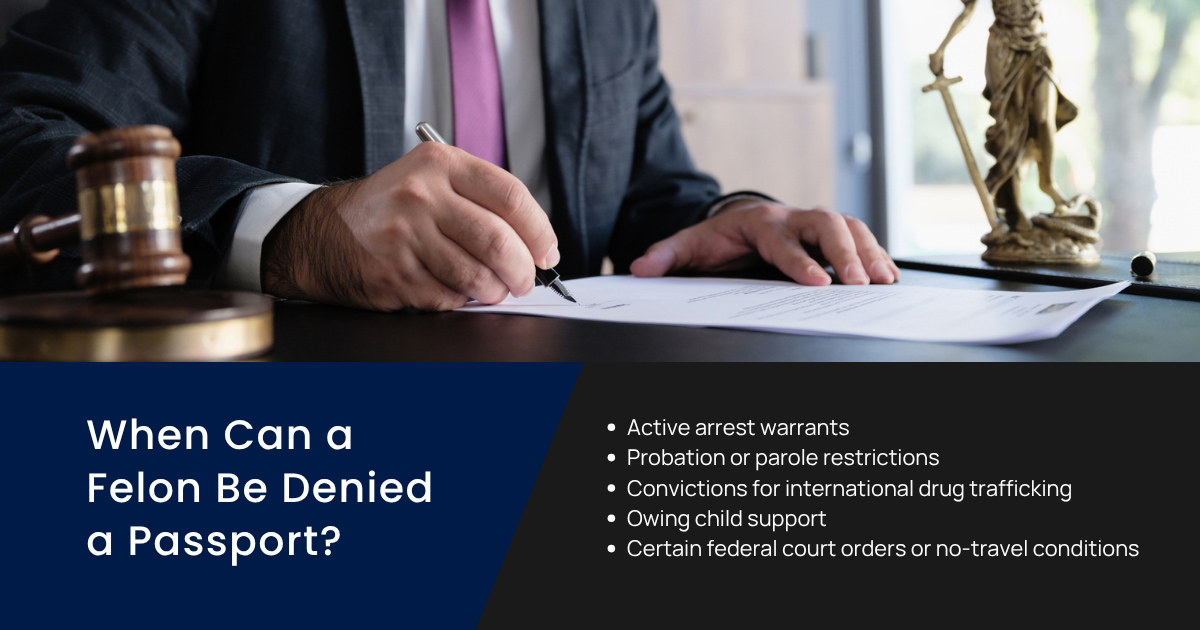
Before you get started on the passport process so you can travel after a felony conviction, it’s wise to determine whether there are circumstances that would lead to a passport application denial. Although most felons are granted permission to obtain a passport, there are certain criminal and civil court situations that can result in a restriction or refusal.
These situations include:
- Active arrest warrants
- Probation or parole restrictions
- Convictions for international drug trafficking
- Owing child support
- Certain federal court orders or no-travel conditions
Active Arrest Warrants
An active, unsealed warrant for your arrest may prevent you from obtaining a passport in accordance with 22 C.F.R. 51.60. Before you can obtain a passport, any outstanding warrant must be either recalled or lifted by court order.
Probation or Parole Restrictions
If you are on parole or probation, it is crucial to review the terms of the associated court order. Some probation and parole orders include restrictions on international travel. Even if no such restrictions exist, it is essential to get your parole or probation officer to write a letter to the passport office to confirm that you have their permission to apply for and obtain a passport. Such permission may be granted in cases of illness or other extenuating circumstances.
Once you have completed the terms of your probation or parole, you may apply for a passport. However, completion of probation or parole does not guarantee you will be allowed to apply for or obtain a passport. If you have been restricted from leaving the United States, the court order must be lifted before getting your passport.
Convictions for International Drug Trafficking
If you have been convicted of international drug trafficking, in accordance with 22 U.S. Code § 2714, you likely had your valid passport revoked at the time of your arrest. While you are serving time in prison or are on probation or parole for this offense, you are unable to apply for a passport. After you have fulfilled the terms of your probation or parole, restrictions on international travel may still exist.
Child Support Arrears
According to the Department of State, if you owe over $2,500 in child support, you will be denied a passport. Back child support must be paid in full before you can obtain a passport. If you pay child support in installments, you may speak with the local child support enforcement agency to make payment arrangements. Consult with the attorneys at The Valley Law Group for child support resources to help you fulfill your responsibilities.
After you have paid the required amount, the agency will alert the Department of Health and Human Services (HHS) of your child support payments. At this time, your name is removed from the federal travel restriction list. Once this occurs, your application can be processed.
Federal Court Orders or No-Travel Conditions
If you are subject to a court order that stipulates that you are not allowed to leave the United States, then you will be denied a passport unless you successfully petition to have the order lifted. Various types of felonies can result in a federal no-travel order or passport denial. Convictions of treason, murder, domestic violence, or human trafficking can all result in passport denial.
Applying for the Return of a Passport or Reapplying for a New Passport
In some cases, valid passports are seized, revoked, or canceled by the Secretary of State. If officials took your passport, you may request its return provided that it is not expired
Follow these steps:
1. Compose a Letter
You must write a letter to request the return of your valid passport, then have it notarized. Include the name of the agency that took your previous passport, as well as your complete name, birthdate, phone number, mailing address, social security number, and a photocopy of valid identification.
2. Have Your Probation Officer Send a Letter
After completing either parole or probation, your probation officer must send the Department of State a letter or email containing: the official letterhead or email of the officer, the officer’s signature, their phone number, government email address, and mailing address, and the date that you are to complete your probation.
3. Submit the Request
Once you have prepared the above documents, you may send them via mail or email them.
If your passport expired while you were in custody or you wish to apply for a first-time passport, you must wait until after your case has been finalized and you have successfully completed the terms of your sentence. At this time, you can follow the general passport steps described at the beginning of this blog, but you must also include a notice that you have completed probation or parole. Provide an official discharge notice or an official termination order from your parole or probation officer, or a valid court order ending the probation or parole.
Arizona Set-Aside (Expungement) and International Travel

In the state of Arizona, full expungement of a felony conviction is not a recognized option. Instead, Arizona offers set-asides, with the exception of Arizona Proposition 207 (the Smart and Safe Arizona Act). Proposition 207 further explains ARS 36-2862, which enables those who have a criminal record due to an offense involving marijuana to file a petition for the court to seal their record.
Under the Arizona set-aside law, an individual may file to have their judgment set aside once they have finished their prison sentence or probation period. Having a judgment set aside means any penalties associated with the conviction are released. It is important to note that having a judgment set aside does not mean your record is sealed or expunged. This means that the conviction is still visible to the public, but the record includes a statement that it has been set aside.
How Setting Aside Your Record Can Help
There are several benefits to having your record set aside.
A set-aside may:
- Help clean up your record
- Improve job prospects
- Support passport or visa approvals when foreign countries review criminal history
This option is especially helpful for those who have had non-violent felonies on their criminal record for a long period. While setting aside your conviction doesn’t erase your past, it does demonstrate rehabilitation, which may support your right to international travel. Discover how The Valley Law Group can help you with an expungement and passports.
Traveling as a Felon: Additional Considerations
Traveling outside of the United States is an exciting and educational experience, but it is not always possible for those with felony convictions, even with a valid passport.
Certain countries do not allow felon international travel, while others place restrictions on those with criminal records:
- Canada does not allow entry to individuals who are convicted of a felony or misdemeanor DUI.
- To enter Belgium with a criminal record, you must be able to prove that you are able to pay for the entirety of your trip, including a ticket to return home.
- Australia and the United Kingdom will not allow entry for those who have served 12 or more months in prison.
- Japan does not allow entry to individuals who have served 12 months in prison, and it is equally strict with those who have been convicted of drug crimes and violent offenses.
Other countries may allow you to visit even if convicted of a felony, but you may need a visa or special permission before entering. Due to these stipulations, it is essential to verify the requirements of the country you plan to visit before booking international travel.
How The Valley Law Group Can Help

Facing serious consequences after a felony conviction can be life-changing. It can be even more overwhelming to learn that you may still be subject to restrictions after you have completed your sentence requirements. The Valley Law Group is here to help you address these difficulties via a set-aside or Prop 207 expungements when applicable.
Even with these options, criminal charges can impact your travel plans. Whether you are uncertain about your legal status, unaware of your travel rights, or are facing other difficulties obtaining a passport, hope is not lost. Our team is dedicated to assisting you through the entire legal process. We can help you file motions or appeals to challenge a denial of your passport, petition the court on your behalf, or negotiate with prosecutors to amend a judgment to reinstate your eligibility for a passport.
Passport After A Felony FAQs
Learn more about the most frequent questions posed by those wishing to travel outside the country after a felony conviction.
Obtain a Passport as a Convicted Felon

Do you have a felony on your record and need clarity about your travel rights? Let us review your case. You may be eligible for a set-aside and a fresh start.
The Valley Law Group is here to help you with four convenient locations in Phoenix, Gilbert, Peoria, and Scottsdale. Contact us to schedule a free consultation.
Sources:
- Arizona Judicial Branch. (n.d.). Proposition 207: Marijuana Expungement. Retrieved March 31, 2025, from https://www.azcourts.gov/prop207
- Arizona Revised Statutes § 36-2862. (n.d.). Expungement of marijuana-related offenses. Retrieved March 31, 2025, from https://www.azleg.gov/ars/36/02862.htm
- U.S. Department of State. (n.d.). Surrendered Passport Information. Retrieved March 31, 2025, from https://travel.state.gov/content/travel/en/passports/legal-matters/surrendered-passport.html
- Maricopa County. (n.d.). What does it mean when a judgment is “set aside”? Retrieved March 31, 2025, from https://www.maricopa.gov/FAQ.aspx?QID=337
- 22 U.S. Code § 2714. (n.d.). Denial of passports to certain convicted drug traffickers. Retrieved March 31, 2025, from https://www.govregs.com/uscode/title22_chapter38_section2714
- U.S. Government Publishing Office. (2017). 22 CFR § 51.60 – Denial and restriction of passports. Retrieved March 31, 2025, from https://www.govinfo.gov/content/pkg/CFR-2017-title22-vol1/pdf/CFR-2017-title22-vol1-sec51-60.pdf
- U.S. Department of State. (n.d.). Passports and Child Support. Retrieved March 31, 2025, from https://travel.state.gov/content/travel/en/passports/legal-matters/child-support.html

Jon McCarty has broad experience in a wide variety of criminal defense and family law matters. After graduating from the University of Illinois College of Law with the highest honors, Jon served as Law Clerk to The Honorable David Briones in the United States District Court for the Western District of Texas. After running a successful practice of his own for many years, Jon relocated to Maricopa County where he has continued to strive for excellence through aggressive yet compassionate representation of each client. Jon has been named to the list of Super Lawyers in the area of family law multiple times, and has been recognized for his outstanding commitment to Equal Access to Justice through providing pro bono representation to numerous clients.