

With Gilbert considering local e-bike safety measures, The Valley Law Group (TVLG) explains Arizona’s three-class system, where kids can ride legally, and practical steps parents can take now.
Parents across the East Valley are seeing the same trend. Teens and preteens are riding electric bikes and stand-up scooters through neighborhoods, often at speeds higher than a typical bicycle and sometimes in places where riding is not allowed. On a normal day in Gilbert, drivers might see around 20 solo or paired riders, 10 small groups of three to five, and about five groups of six to 12. Twice a week, there may be a larger group of a dozen or more that is not connected to school traffic. Many residents have had near misses, hitting the brakes as a rider appears from behind a parked SUV or a thick hedge. Limited sight lines, varying rider experience, and assisted speeds that can reach 28 miles per hour on Class 3 e-bikes create closing speeds that surprise even careful drivers (Arizona Revised Statutes § 28-819, 2025).
As Gilbert officials review local options to reduce injuries and continue education through the Know Your Ride program, The Valley Law Group is sharing a plain-English guide to help families understand current Arizona law, how Gilbert’s efforts fit into that framework, and what could change if new rules are adopted (KJZZ, 2025; 12News, 2025a; Gilbert Police Department, 2025a, 2025b). Parents consistently ask two things: where their kids can legally ride and what the real risks are when they do not follow the rules. Arizona’s three-class system becomes much clearer once you see how device class and path access work. Gilbert’s education push gives families a good opportunity to reset expectations at home.
Why This Matters Now
Gilbert Police launched the Know Your Ride campaign to help families understand the differences between electric bicycles and electric motorcycles and to clarify which laws apply to each. The department has focused on education while still pointing out that enforcement tools are available when riding becomes unsafe or unlawful (Gilbert Police Department, 2025a; 12News, 2025a). Local news outlets have reported an increase in youth-involved crashes, with some periods where officers responded to several e-bike injury calls in only a few months. That uptick has led to renewed outreach and a broader discussion about possible rule changes (12News, 2024; 12News, 2025b). Gilbert’s Town Council has also begun exploring options such as helmet expectations for minors and additional local standards aimed at reducing injuries (KJZZ, 2025).
Arizona’s Three-class e-bike System
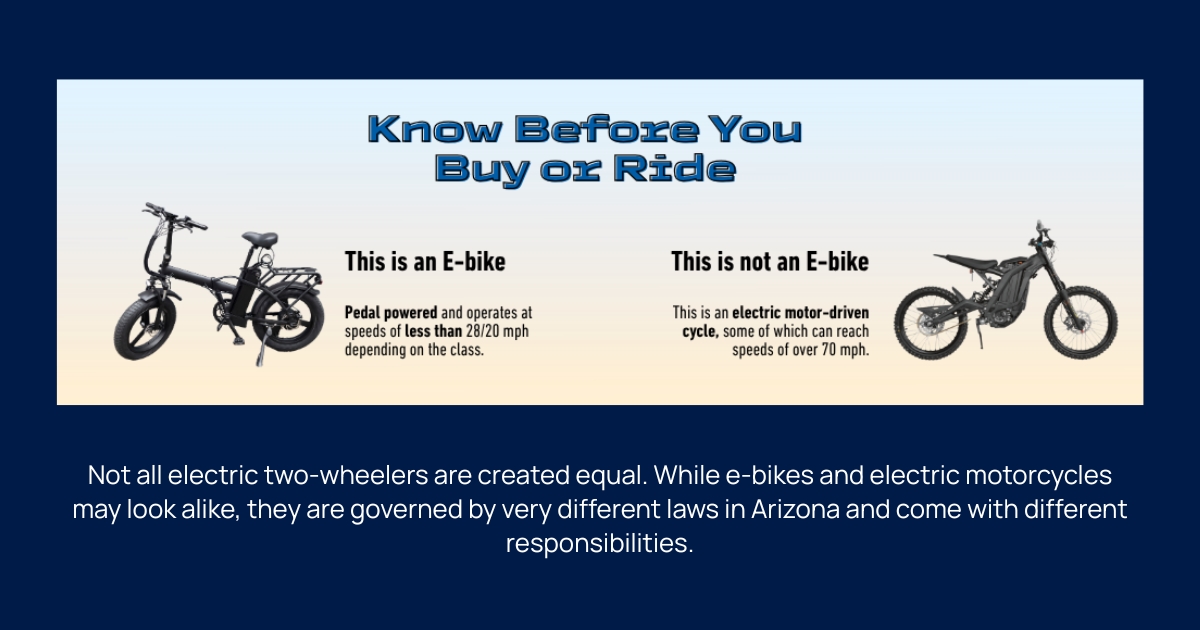
Arizona law recognizes three classes of electric bicycles. A true e-bike has fully operable pedals and an electric motor of less than 750 watts. If a device does not have working pedals or appears to exceed class limits, it may be considered a motor-driven cycle or an electric motorcycle instead.
Those categories have very different requirements for riders (Arizona Revised Statutes § 28-101, 2025; § 28-819, 2025).
- Class 1: Pedal assist only. The motor stops helping at 20 mph.
- Class 2: Has a throttle. Assistance or throttle use is capped at 20 mph.
- Class 3: Pedal assist only. Motor assistance stops at 28 mph.
Manufacturers and distributors must place a permanent label on the device that lists the class, top assisted speed, and motor wattage. That label helps parents, riders, and officers quickly understand what the bike is designed to do (Arizona Revised Statutes § 28-819, 2025).
Where Kids Can Ride Under State Law
On public roads, e-bikes are generally treated like bicycles for licensing, registration, and insurance, unless a local rule says otherwise (Arizona Revised Statutes § 28-819, 2025). On bicycle and multi-use paths, Class 1 and Class 2 bikes are usually allowed unless a local authority restricts them on a specific path. Class 3 bikes are usually not allowed on multi-use paths unless the path runs within or next to a roadway or a local authority gives explicit permission.
Practical Note for Parents
Path access is a common area of confusion. Class 3 bikes, which can assist up to 28 mph, are often restricted on canal and park paths unless the path is tied to a roadway or local signs permit it. Before a ride, parents should check posted signs and any guidance from the town (Arizona Revised Statutes § 28-819, 2025).
What Gilbert is Doing Now
Education first.
Gilbert’s Know Your Ride initiative focuses on helping families understand the difference between an e-bike and an electric motorcycle and which laws apply to each. The goal is to reach parents before they purchase a device and to reach kids before risky habits develop. The police department has also shared safety reminders during high-activity periods such as back-to-school and fall break (Gilbert Police Department, 2025a, 2025b, 2025c).
Local rulemaking.
Arizona law gives cities and towns the ability to tailor certain rules, including path access and other safety measures (Arizona Revised Statutes § 28-819, 2025). Gilbert’s leaders have been reviewing options aimed at reducing youth injuries, and local news outlets have reported that rising teen crashes have prompted council members to consider possible next steps (KJZZ, 2025; 12News, 2025b).
Proposed safety steps.
Town leaders are also discussing several potential safety measures. Ideas include clearer path signage, targeted patrols near schools and parks, community briefings with parent groups, and the use of technology such as drones and other monitoring tools where lawful and appropriate. These proposals are still under review. Any changes would be announced through Gilbert’s official channels, so families should follow the Town and Gilbert Police updates as discussions move forward (12News, 2025a; Gilbert Police Department, 2025b; KJZZ, 2025).
Common e-Bike Legal Mistakes Families Can Avoid
1) Buying a device that is not an e-bike under Arizona law.
If a device does not have fully operable pedals or appears to exceed class limits, it may be classified as a motor-driven cycle or an electric motorcycle instead of an e-bike. Those categories carry very different rules about where the device can be operated and what is required of the rider (Arizona Revised Statutes § 28-101, 2025).
2) Riding Class 3 on off-road multi-use paths.
Unless a town gives express permission, Class 3 e-bikes are usually not allowed on multi-use paths that are not adjacent to a roadway. Many families discover this only after a citation or a close call (Arizona Revised Statutes § 28-819, 2025).
3) Assuming “no statewide helmet law” means helmets are unimportant.
Arizona does not have a statewide helmet requirement for e-bikes, but cities and towns can adopt additional safety measures. Schools, clubs, and sports teams often set their own rules as well. Gilbert’s public discussions have included the possibility of helmet expectations for minors due to the severity of recent injuries (KJZZ, 2025).
4) Group rides that block traffic
Gilbert Police have warned about large group rides, especially at night or near busy shopping areas, that create unsafe or unlawful conditions. Education is the first step, but repeated or dangerous behavior can lead to citations and even impounds (12News, 2025a; Gilbert Police Department, 2025c).
A Parent e-bike Checklist Before Your Child Rides
1) Read the label.
Confirm the class, top assisted speed, and motor wattage. If the bike does not have a permanent label, contact the seller or manufacturer for clarification (Arizona Revised Statutes § 28-819, 2025).
2) Confirm it is truly an e-bike.
Check for fully operable pedals and make sure the specifications fit within class limits. If not, the device may be regulated as a motor-driven cycle or an electric motorcycle, which has very different requirements (Arizona Revised Statutes § 28-101, 2025).
3) Match the device to the route.
Class 1 and Class 2 e-bikes are usually allowed on canal or park paths unless posted otherwise. Class 3 is typically restricted unless the path is alongside a roadway or a local rule permits it (Arizona Revised Statutes § 28-819, 2025).
4) Set family rules.
Make helmets part of every ride, require lights at night, and avoid earbuds or phone use while moving. Teach riders to obey stop signs, slow at driveways, and follow yield rules (Gilbert Police Department, 2025a, 2025b).
5) Know the local conversation.
Check the Town of Gilbert Digital Newsroom and Council agenda pages for meeting notices and ordinance updates. Follow the Gilbert Police Department’s Know Your Ride page for current education and enforcement guidance. Families can also enroll in the RAVE alerts system for timely notices (Gilbert, Arizona, 2025; Gilbert Police Department, 2025a, 2025b, 2025c).
What To Do if There is a Crash or a Citation
Outcomes in injury and traffic cases often depend on how the device is classified, where it was being operated, and whether the rider followed required equipment and speed rules. Early legal guidance can help families handle insurance questions, medical bills, and municipal citations before small issues become larger problems.
The Valley Law Group recommends documenting everything while the details are fresh. Take photos of the bike’s class label, the route, and any signage. Note nearby intersections, driveways, or visibility issues that may have contributed to the incident.
We are seeing cases where the classification of the device plays a major role in the result. Parents who check the label, understand path rules, and set clear family guidelines are protecting their children and themselves.
Frequently Asked e-bike Questions for Parents:
How TVLG Can Help After an e-bike Incident
If you or your child was injured on an e-bike or scooter, or if you were driving and were involved in a collision with a rider, The Valley Law Group offers a no-cost initial consultation. We help families and drivers understand their options, the likely timeline, and what to do next. Our team evaluates the facts through the lens of Arizona law, including how device classification, path rules, signage, visibility, and rider or driver conduct may affect responsibility.

During your consultation, we can:
- Outline first steps for medical care, documentation, and insurance notifications
- Review photos and videos, police reports, witness details, and location signage
- Verify device details such as class label, motor limits, and equipment
- Explain how comparative fault works in Arizona and what that means for your case
- Provide a simple action plan for the next 24 to 72 hours
We speak with injured riders, passengers, pedestrians, and drivers. Whether you were hit or you hit someone, early guidance can prevent mistakes and protect your rights. There is no obligation. Call our office to schedule a same-day or next-day appointment, or contact us here to request a time that works for you.
Responsible Riding Starts at Home
The safest rides start long before a child gets on an e-bike. Parents who take time to walk through the basics like device class, where the bike is allowed to travel, how to stay visible, and what counts as a safe speed give their kids a real advantage on the road. Arizona law provides the framework, and Gilbert’s ongoing education efforts help families understand how those rules apply locally.
At The Valley Law Group, we encourage families to keep safety simple: read the label on the device, make sure the class matches the route, and treat helmets as non-negotiable. A few proactive conversations at home can prevent many of the injuries we see after avoidable e-bike crashes.
References
- 12News. (2024, April). Gilbert police start educating community about e-bike laws after 11 injury calls. Retrieved October 15, 2025, from
https://www.12news.com/article/news/local/valley/11-injury-calls-prompt-gilbert-police-start-educating-community-about-e-bike-laws-safety/75-a1b4cde7-c057-4fc9-96e2-fa90cb92929d - 12News. (2025a, October 9). Gilbert police using technology to crack down on illegal electric motorbike use. Retrieved October 15, 2025, from
https://www.12news.com/article/news/local/valley/gilbert-police-using-technology-crack-down-illegal-electric-motorbike-use-arizona/75-265259df-0f4c-4322-94f0-d20b98055b41 - 12News. (2025b, May). Mom of Gilbert teen seriously hurt in motorbike crash shares warning with community. Retrieved October 15, 2025, from
https://www.12news.com/article/news/local/valley/mom-of-gilbert-teen-seriously-hurt-in-motorbike-crash-sharing-warning-with-community/75-fa5bee42-5154-40f6-bcc8-41856db3e777 - Arizona Revised Statutes § 28-101. (2025). Definitions. Retrieved October 15, 2025, from
https://www.azleg.gov/ars/28/00101.htm - Arizona Revised Statutes § 28-819. (2025). Electric bicycles; electric standup scooters. Retrieved October 15, 2025, from
https://www.azleg.gov/ars/28/00819.htm - Gilbert Police Department. (2025a). Know Your Ride. Retrieved October 15, 2025, from
https://www.gilbertaz.gov/departments/police/about-us/know-your-ride - Gilbert Police Department. (2025b). Introducing “Know Your Ride”: Understanding e-bikes, e-motos, and the laws that apply. Digital Newsroom. Retrieved October 15, 2025, from
https://www.gilbertaz.gov/Home/Components/News/News/6458/1379 - Gilbert Police Department. (2025c). Fall break safety reminders (Know Your Ride highlights). Digital Newsroom. Retrieved October 15, 2025, from
https://www.gilbertaz.gov/Home/Components/News/News/6491/1379 - KJZZ. (2025, August 27). Gilbert looking at options to reduce injuries from e-bike collisions. Retrieved October 15, 2025, from
https://www.kjzz.org/politics/2025-08-27/gilbert-looking-at-options-to-reduce-injuries-from-e-bike-collisions

Jon McCarty has broad experience in a wide variety of criminal defense and family law matters. After graduating from the University of Illinois College of Law with the highest honors, Jon served as Law Clerk to The Honorable David Briones in the United States District Court for the Western District of Texas. After running a successful practice of his own for many years, Jon relocated to Maricopa County where he has continued to strive for excellence through aggressive yet compassionate representation of each client. Jon has been named to the list of Super Lawyers in the area of family law multiple times, and has been recognized for his outstanding commitment to Equal Access to Justice through providing pro bono representation to numerous clients.